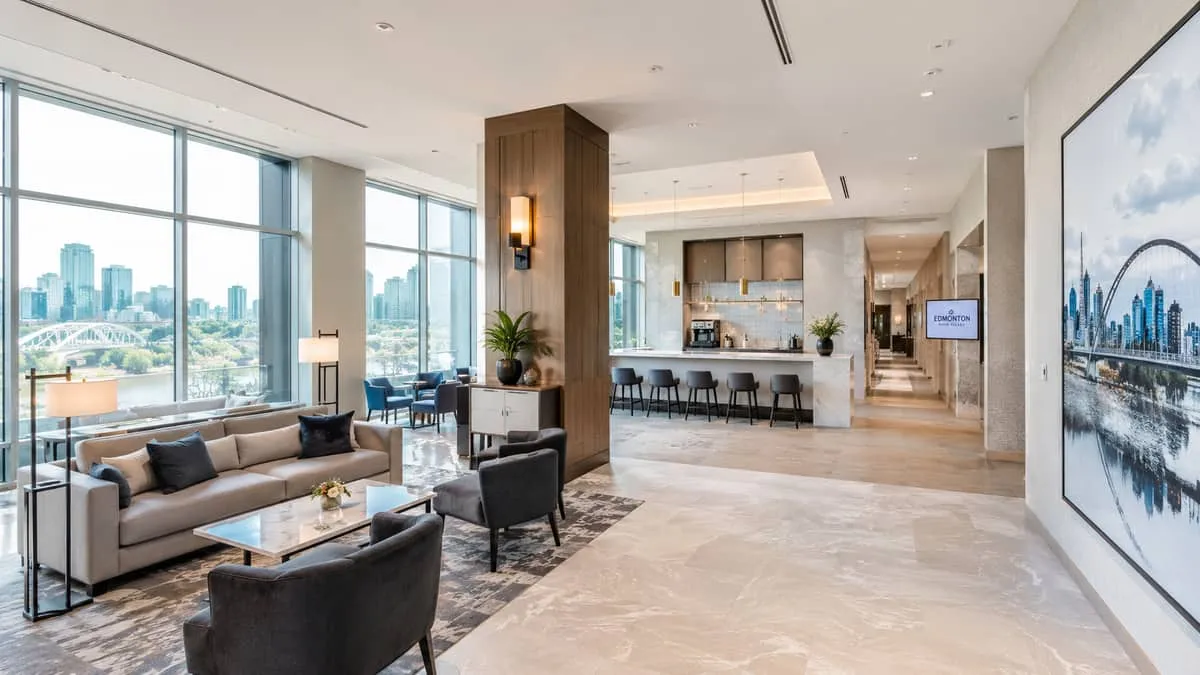
Edmonton is in the middle of one of the most active hotel development cycles in its history. The Ice District has reshaped what downtown hospitality looks like, the airport corridor is filling with flag properties serving oil patch rotational workers and government delegations, and the West Edmonton Mall hotel cluster keeps generating occupancy numbers that make national brands pay attention. Alongside that, a quieter but meaningful wave of independent restaurants has taken hold on Whyte Avenue and along 124th Street, where operators are doing serious design work on tighter budgets.
What all of these projects share is a procurement problem. Getting the right commercial furniture specified, ordered, and installed before an opening date is harder than most owners expect, and the Alberta market has its own specific wrinkles that trip up teams unfamiliar with it.
This is how FF&E procurement actually works in Edmonton, what drives cost and timeline, and what separates the projects that open on schedule from the ones that scramble.
Understanding the Scope Before You Start Spending
FF&E stands for furniture, fixtures, and equipment. In a hospitality build, that means guestroom case goods, upholstered headboards, lobby seating, restaurant tables and chairs, bar stools, lounge soft seating, task lighting, and decorative artwork. It does not mean the commercial kitchen equipment, plumbing fixtures, HVAC systems, or built-in millwork. Those belong to separate scopes.
The reason this distinction matters operationally is that different vendors, different timelines, and different professionals manage each category. Your general contractor handles the base building. Your millwork fabricator handles built-ins. Your interior designer specifies FF&E, and either they or a dedicated procurement agent executes it.
On large Edmonton convention hotel projects , the kind of full-service, 200-plus room properties targeting the convention and government travel market , the scope confusion between FF&E and millwork causes real problems. A decorative pendant light gets specified by the designer but isn't assigned to a purchasing agent. The GC assumes it's in FF&E. The procurement agent assumes it's in the electrical scope. Nobody orders it. You find out three weeks before opening.
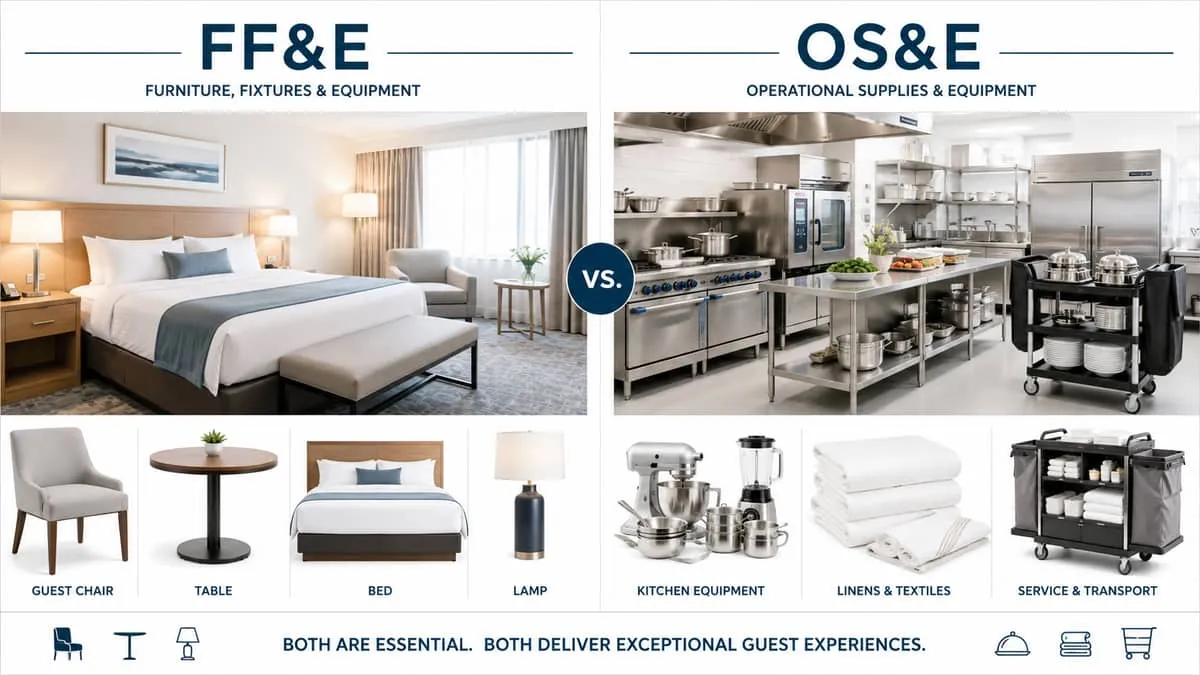
The fix is a scope document produced early , a schedule of finishes that explicitly separates FF&E from millwork, from OS&E (operating supplies and equipment), and from base building. That document has to be signed off by the owner, the designer, the procurement agent, and the GC. In a market like Edmonton where convention hotel projects involve multiple contractors and often phased construction timelines, this alignment step is not optional.
Edmonton Hotels Spec for Durability First , Here's Why That Changes Procurement
Edmonton's hospitality market is not primarily a leisure market. The dominant demand drivers are corporate travel from the energy sector, government and healthcare delegations, construction crews running rotational schedules, and convention business anchored by the Shaw Conference Centre and the growing Ice District event infrastructure around Rogers Place. That mix shapes what hotel operators actually specify when it comes to furniture.
Where a boutique hotel in Vancouver or Montreal might spec upholstered seating with a fashion-forward fabric and a four-year refresh cycle baked into the budget, Edmonton operators buying for corporate-focused properties are making ten-year durability decisions. The furniture needs to take sustained, heavy use from guests who are working, not vacationing. Guestroom desk chairs, lobby seating, and restaurant banquettes in corporate Edmonton properties get used hard.
What this looks like in procurement terms: Edmonton hotel buyers prioritize frame construction and abrasion resistance over aesthetic novelty. Kiln-dried hardwood or welded steel frames, eight-way hand-tied or sinuous spring systems, and fabrics rated to 100,000 double rubs or higher are standard asks on full-service corporate properties. COM (customer's own material) selections , where the designer specifies a custom fabric sent to the furniture manufacturer , are common on boutique projects but less frequent on large convention properties where the focus is on proven, warrantied contract grades.
This is a meaningful distinction for procurement. A buyer focused on durability and warranty terms approaches the vendor conversation differently than one focused on aesthetic differentiation. Lead times, pricing structures, and sample review processes all look different depending on which priority dominates the spec.
For the growing number of extended-stay and limited-service properties along the airport corridor and in Edmonton's south and west suburban clusters, the durability focus is even more acute. These properties are serving rotational oil patch workers on weekly or monthly stays. The furniture takes punishment. Procurement for these projects skews heavily toward commercial-grade case goods with laminate or thermofoil surfaces over solid wood veneer, upholstered pieces with removable and washable seat cushions, and metal-base chairs that can be cleaned quickly.
The Alberta Logistics Reality , Why Your Timeline Is Longer Than You Think
Custom upholstered commercial furniture runs 16 to 22 weeks from confirmed purchase order to delivery. That's industry standard and applies whether you're buying in Edmonton or anywhere else. What's not industry standard is the additional freight complexity of getting product into Alberta.
Most contract furniture manufacturing for the Canadian market runs through facilities in Ontario, Quebec, or the US Southeast. Product shipped to Alberta moves through either the Port of Vancouver or overland from eastern Canada. Both routes have friction points. Vancouver port delays affect shipping containers from overseas suppliers. Overland freight from Ontario has added transit time and, in winter months, weather-related delays through the mountains or across the prairies.
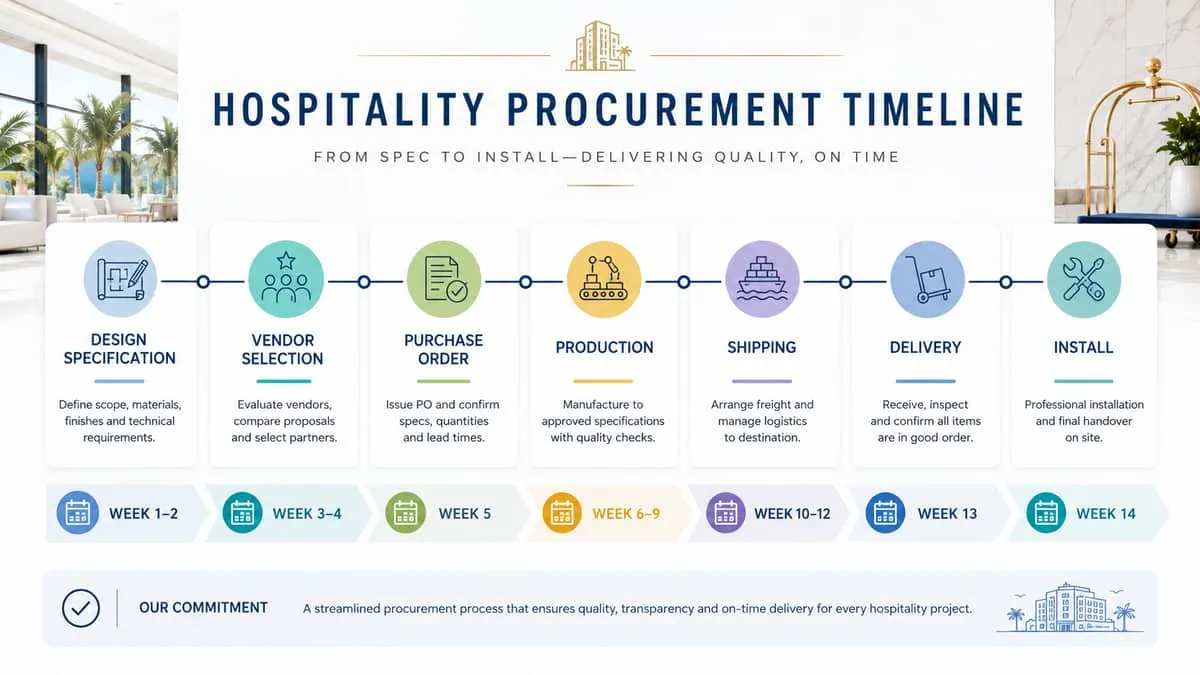
Edmonton openings in February or March , which happen regularly given that construction schedules push into winter , carry real freight risk. A delivery window that works in October becomes a problem when a blizzard grounds trucks in Saskatchewan for three days. Build buffer into your receiving schedule. If you're targeting a late-winter opening, your purchase orders need to be signed six to seven months out, not the standard five.
There's also a local inventory reality worth understanding. Edmonton has commercial furniture dealers and distributors, but the in-stock depth for contract-grade hospitality product is thinner here than in Toronto or Vancouver. Quick-ship programs that work well in larger markets may not cover everything you need, and lead times on special orders reflect the additional freight step. Working with a supplier who has established relationships with Alberta freight carriers and understands the receiving infrastructure at Edmonton's commercial properties matters more here than it would in a gateway city.
Coordinating Procurement on Large Convention Hotel Builds
The convention hotel segment is where Edmonton's FF&E procurement gets genuinely complex. A 300-room full-service property with a 20,000-square-foot ballroom and multiple food and beverage outlets is not a procurement project , it's a procurement program. The number of line items, vendors, lead times, and installation sequences involved requires dedicated management.
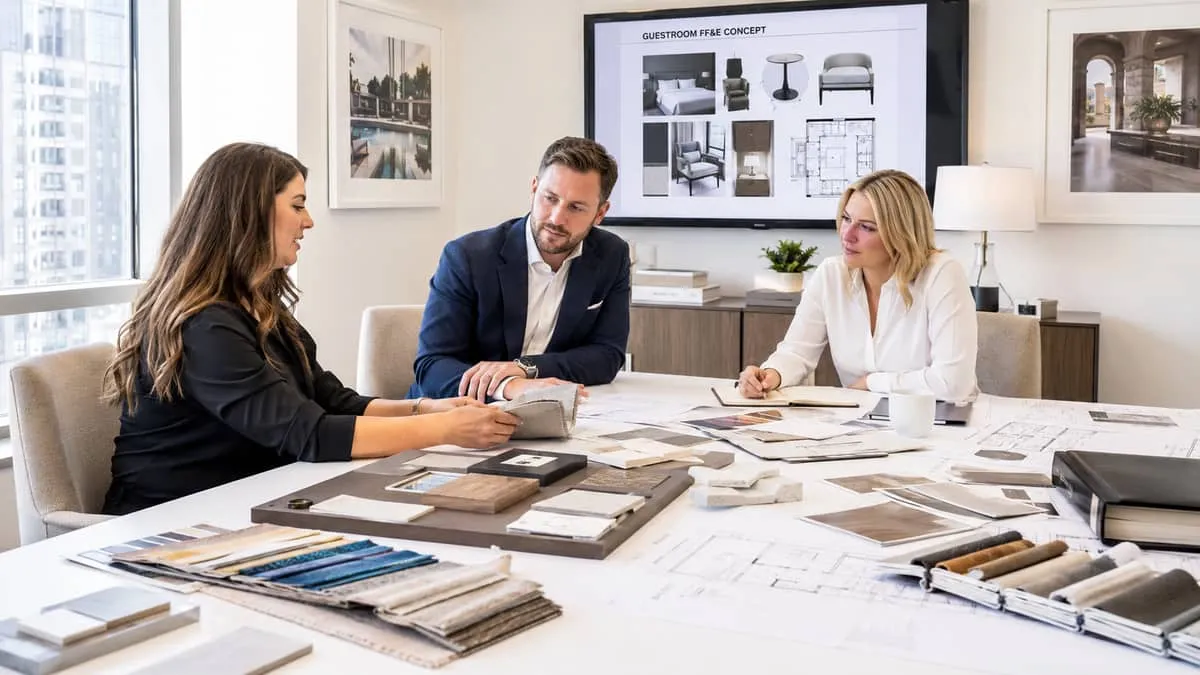
On projects of this scale, a procurement agent is not optional. The agent manages the master FF&E schedule, coordinates with the GC on phased installation access, handles vendor production tracking, manages freight consolidation, and runs the punch list process after installation. The interior designer stays focused on specification and design decisions. The owner focuses on the build. The agent holds everything else together.
What distinguishes a strong FF&E procurement agent in the Edmonton market is Alberta-specific experience. Understanding which vendors have established freight lanes into Edmonton, which ones have navigated the receiving constraints of downtown builds in the Ice District (where truck access and staging space are limited), and which ones have track records on convention-scale hospitality projects , that knowledge shortens timelines and prevents the vendor substitution scrambles that derail large builds.
For convention hotel projects specifically, installation phasing is as important as procurement execution. Guestroom floors are typically installed floor by floor as the GC hands off each level. Public areas install last, often in a compressed window before opening. A procurement agent who has done this before knows how to sequence vendor deliveries to match the GC's handoff schedule, not the other way around.
Independent Restaurant Procurement: Whyte Avenue and 124th Street
The independent restaurant segment in Edmonton is doing interesting things. Whyte Avenue operators are mixing vintage aesthetic with contract-grade durability , sourcing statement pieces that look collected but can handle a full Friday service without showing damage. Along 124th Street, where the dining is more chef-driven and the rooms tend to be smaller and more considered, operators are investing more per seat and expecting longer lifespans from each piece.
For both markets, procurement works differently than on hotel builds. The timelines are shorter because the seat counts are lower. A 60-seat restaurant can be fully procured in four months if the designer has the spec locked early. But the lead time reality is the same: custom upholstery still takes 16 to 22 weeks. The mistake independent operators make consistently is starting the furniture conversation after the design is finalized and permits are in, then discovering they're three months from opening and six months from receiving custom seating.
The practical approach for independent restaurant projects is to flag the long-lead items , custom banquettes, upholstered dining chairs, statement lounge pieces , at the concept design stage and get those on order before everything else is decided. Off-the-shelf commercial seating with quick-ship availability can be worked in for supplemental pieces, but the custom or semi-custom items that define the room's character need to move early.
For Edmonton operators on a tighter budget, the durability math still applies. A restaurant chair at $180 that survives three years of daily service costs $60 per year. A chair at $80 that requires replacement in 18 months costs $53 per year , and the disruption of replacing chairs mid-operation is its own cost. The Alberta preference for durability over initial price point is rational when you run the numbers.
Budget Reality for Edmonton Hospitality Builds
FF&E budgets in Edmonton vary significantly by property type and target market. Airport corridor and suburban limited-service hotels, where the demand is functional and the guest is a repeat corporate traveler who wants a clean room and a reliable bed, typically budget $8,000 to $13,000 per key for FF&E. The spec leans toward durability and ease of maintenance, not design distinction.
Full-service downtown and convention-adjacent properties , the ones competing for government delegations, energy sector corporate accounts, and convention overflow from the Shaw Centre , run $20,000 to $35,000 per key and sometimes higher when the public areas involve significant custom or designer-specified pieces. The Ice District properties coming online are targeting premium corporate and entertainment traveler business, and the FF&E investment reflects that positioning.
Restaurant budgets in Edmonton's independent scene range from $450 to $700 per seat for casual full-service operations running practical commercial product, up to $1,400 to $2,200 per seat for chef-driven rooms with custom millwork-integrated seating, statement lighting, and higher-end upholstery. The 124th Street tier is at the higher end of that range. Whyte Avenue sits in the middle, where operators want quality but are also dealing with lower revenue-per-seat math in a neighborhood that's still building its premium dining reputation.
These budgets are most accurate when scope is clean. When FF&E, millwork, and OS&E budgets are blended or poorly defined, cost overruns happen at the boundaries , and they always get attributed to FF&E because that's where the visible, touchable product lives.
Starting the Conversation at the Right Time
The consistent failure mode in Edmonton hospitality procurement is starting too late. Owners treat furniture as a late-stage decision because it feels like a finishing step. It isn't. The specification decisions that drive your furniture order happen at the design development stage, and the purchase orders need to follow as soon as specifications are locked , not after construction is complete and you're counting down to opening.
For a hotel project in the Ice District or along the airport corridor, procurement conversations should begin when the design development package is 60 to 70 percent complete. For a restaurant on Whyte Avenue or 124th Street, start when you have a layout and a concept direction , even if finishes aren't fully decided.
If you're in the planning phase of an Edmonton hospitality build right now, the most valuable thing you can do is get a preliminary FF&E scope defined and a rough timeline built before the construction schedule locks in around you. The Alberta market has its own freight realities, its own vendor landscape, and its own durability expectations. Working with a supplier who understands that landscape from the start changes what your opening day actually looks like.
Pricing for FF&E in Edmonton depends on quantities, finishes, and your delivery window, so a project-specific quote beats any list figure. Request a quote to get yours.