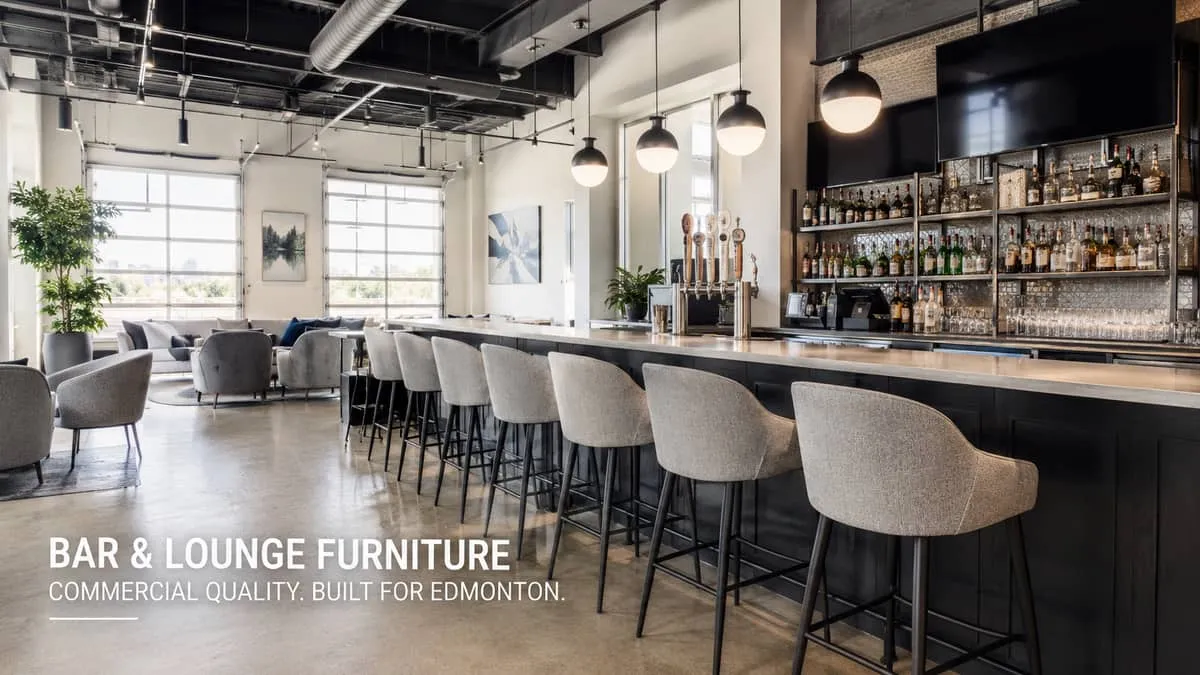
Edmonton has the highest concentration of sports bars, hotel lounges, and cocktail bars per square block in Alberta, and almost all of them sit within walking distance of Rogers Place. The Ice District built around the arena has changed the physics of Edmonton's hospitality market in ways that most furniture suppliers still haven't caught up to. On an Oilers game night, the bars along 104th Avenue and the hotel properties on 102nd and 103rd Street are doing volumes that have no equivalent anywhere else in the province. That kind of volume doesn't just test furniture , it destroys furniture that isn't built for it.
This is the operating reality that should be driving every specification decision for bar lounge furniture in Edmonton's Ice District and the venues that serve its crowd. It's also why the spec conversations that matter here are different from what you'd have for a neighbourhood bar in any other Canadian city.
What 800 Covers on a Game Night Actually Means for Your Furniture
The Rogers Place capacity is 18,347 for hockey. The bars immediately surrounding the arena , Tuesdays, the Ice District Plaza venues, and the hotel bars attached to the JW Marriott and other Ice District properties , collectively absorb thousands of those fans before and after the drop of the puck. A sports bar doing 800 covers across a four-hour pre- and post-game window isn't exceptional in this district. It's Tuesday in October.
At that volume, every furniture failure becomes immediate and visible. A bar stool with a loose footrest weld becomes a complaint within two hours. Booth seating with underspecified foam goes flat by the third quarter of the season. Tabletops without commercial-grade edge sealing chip under the constant impact of pint glasses and the scraping of stools being pulled in and out.
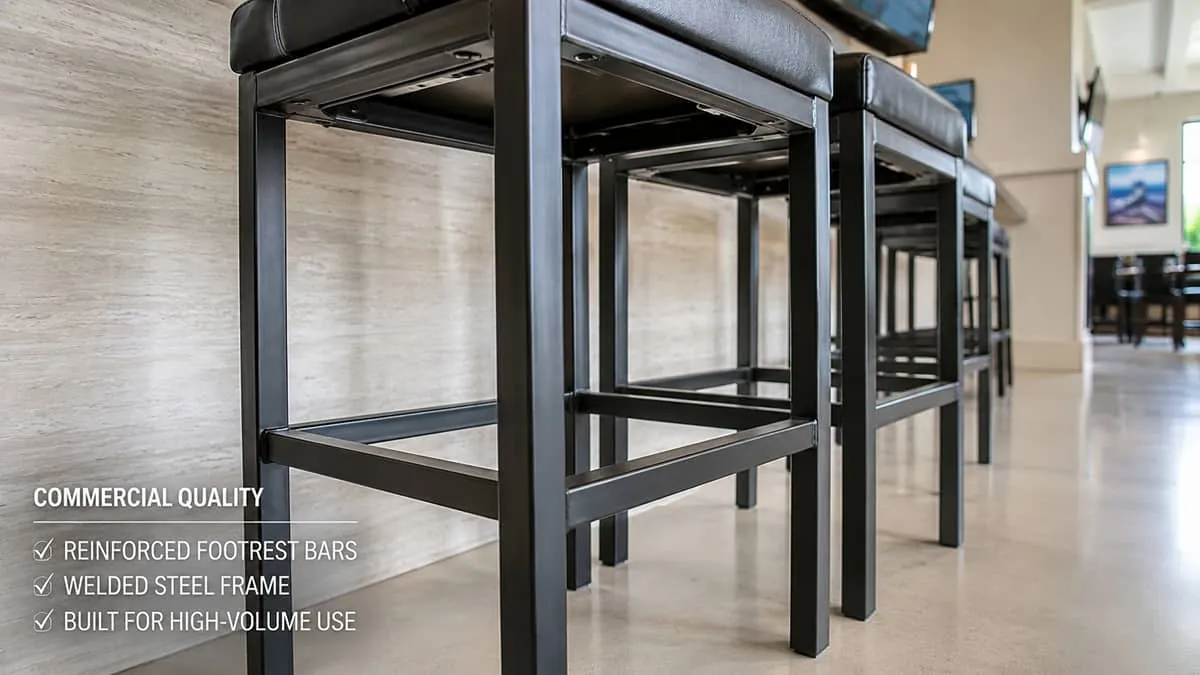
Contract-grade bar stools rated for commercial use carry a minimum 250,000 double rub abrasion rating on upholstery and frames built with continuous welded steel , not bolted connections at the stress points. For an Ice District sports bar, that rating is the floor, not the premium. The footrest on a bar stool takes the full force of guests climbing up and pushing off, repeated hundreds of times per night across a six-month hockey season. Footrests on contract stools are welded to the frame tube, not attached with hardware that works loose over time. On retail-grade pieces, the footrest joint is typically the first failure point, and it fails fast under sports-bar volumes.
Booth seating deserves the same scrutiny. A booth running along the perimeter of an Ice District bar needs commercial-grade foam at a minimum of 1.8 lb density to maintain its profile across a season. Below that density, the foam compresses to a fraction of its original depth within months. By December, guests are sitting on what feels like a wooden bench covered in vinyl. That's a direct hit to the experience you're selling and to the review scores that drive return visits.
The Stool-to-Booth Ratio That Actually Works for Sports Bar Format
Edmonton's sports bar format has a specific geometry. Guests arrive in groups ranging from two to eight, they want sightlines to multiple screens, they rotate between standing and sitting as the game builds, and they're ordering rounds at a pace that means servers need clear sight lines to flag them down. The furniture layout has to serve all of that simultaneously.
The configuration that works in the Ice District follows a layered approach. The bar counter itself runs stools at 28-30 inch seat height with footrests at 10 inches from the floor , the standard commercial height that aligns with a 42-inch bar top. Behind the bar counter, a high-top zone with 36-inch tables and 28-inch stools captures the standing-to-sitting transition that happens during tense game moments. Groups who want to watch standing simply push their stools aside; the table holds the drinks. Further back, lower booth seating at 18-inch seat height serves guests who are committing to the full game and want to settle in.
That three-zone progression is not a design preference. It's a functional response to how the crowd actually uses the space. Operators who skip the high-top zone and go straight from bar counter to low booths end up with a floor that doesn't flex when the crowd dynamic shifts between periods.
For the stools themselves, swivel bases with a 360-degree rotation are worth the specification in a game-night context. Guests are constantly turning to talk to adjacent groups, flagging servers, and shifting to catch screens in different directions. A fixed-position stool creates constant friction in a high-energy crowd. The swivel mechanism on contract stools is rated for the rotation volume , it won't develop play or squeak within a season the way residential swivel bases do.
Upholstery Decisions for a Bar That Pours on Game Night
Beer spills are a given at an Oilers game. So are cocktails, and increasingly so are the food programs that Ice District bars have added to keep covers at the table through the full arc of a game night. Upholstery that can't be wiped between covers in under two minutes is not viable in this environment.
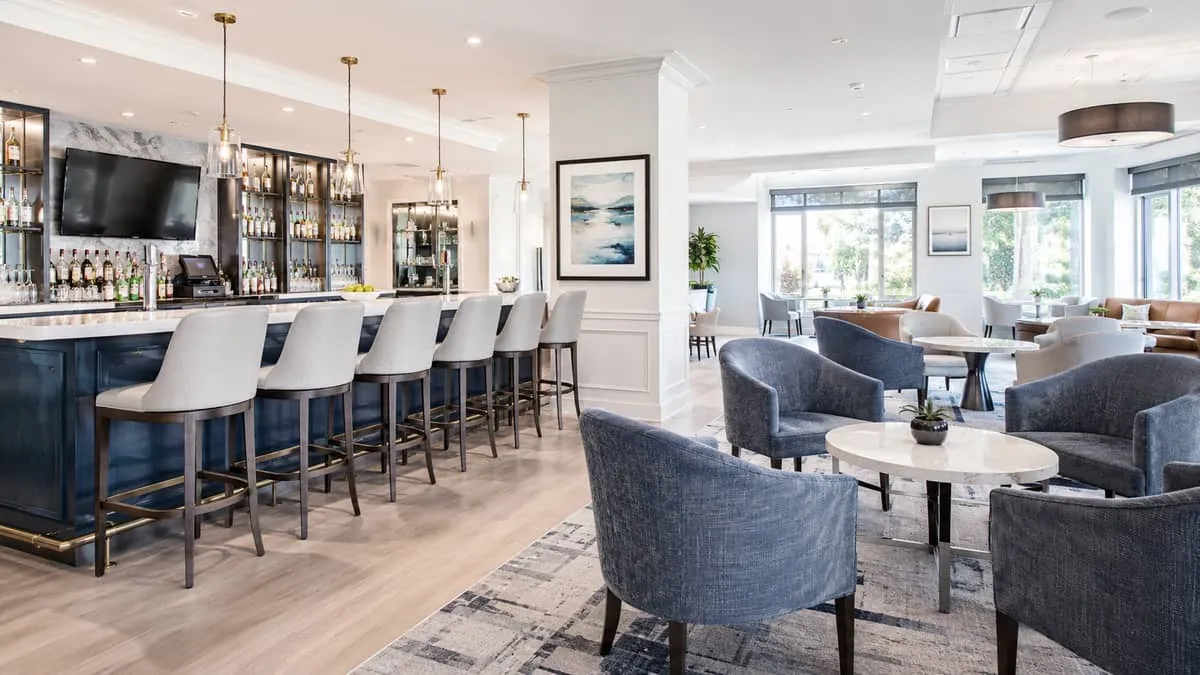
For bar counter stools and high-top seating in the sports bar zone, commercial vinyl is the correct specification. The grade A contract vinyls available now have moved far past the association with sticky, cracking surfaces. They carry texture depth and colour saturation that holds up visually alongside quality finishes, and they wipe completely clean with a damp cloth. For a bar doing 800 covers, that wipe-down time is a real operational variable , vinyl seating can be turned for the next guest without a deep clean.
Booth seating in the lower lounge zones of the same venue can carry a treated performance fabric, which reads more settled and comfortable for guests who are staying through a three-period game plus overtime. The key specification is that performance fabric needs a commercial abrasion rating of 100,000 double rubs minimum and a treatment that handles liquid repellency. Scotchgard-style treatments applied at the factory , rather than added in the field , hold up properly through commercial laundering and regular cleaning cycles.
The colour and finish decisions for Ice District properties tend to run darker than in other Edmonton contexts. Charcoal, navy, deep forest green, and black are practical choices in a sports bar because they absorb the visual noise of a full room and show spills and wear far less than lighter tones between cleaning cycles. That's not an aesthetic compromise , darker upholstery in a high-volume sports bar is a maintenance decision that directly affects the venue's appearance at the end of a long game night.
124th Street and the Craft Cocktail Bar Specification
The emerging cocktail bar scene on 124th Street is operating in a completely different register from the Ice District volume play. Bars like Woodwork, Clementine, and the independent cocktail lounges that have opened along the corridor over the last three years are building concepts where the furniture is part of the experience proposition, not a functional baseline.
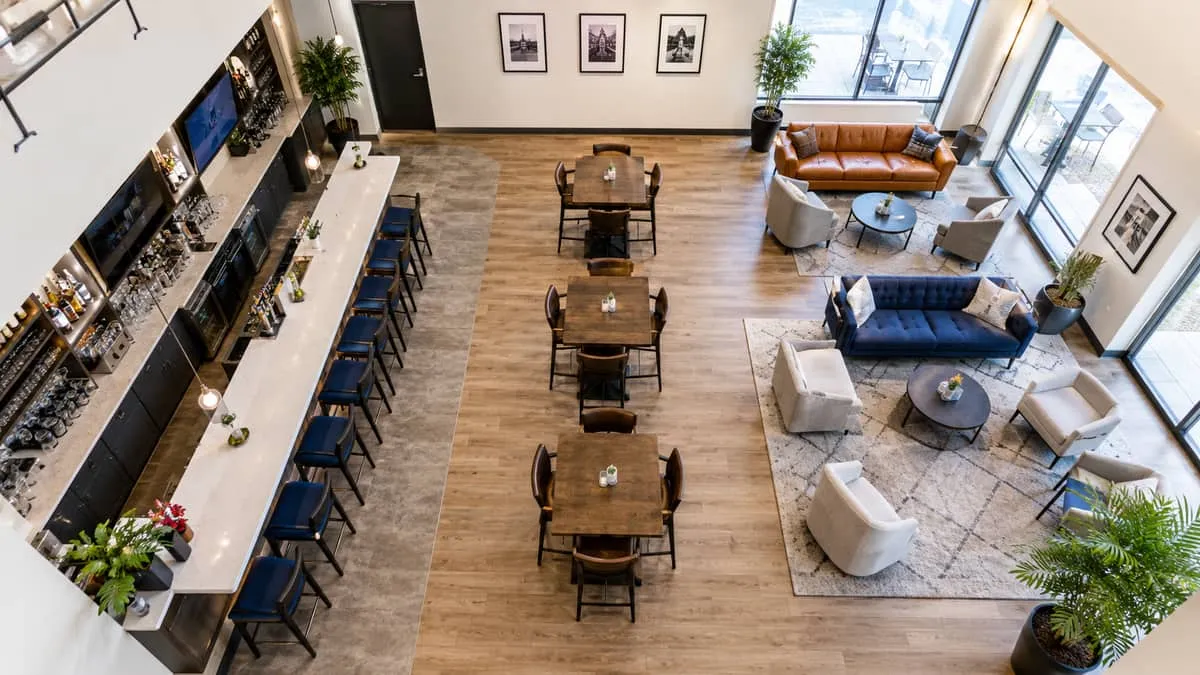
The 124th Street crowd is younger, arts-district oriented, and increasingly sophisticated about the difference between a space that has been considered and one that has been furnished. Operators on this strip are specifying mixed-material pieces , wood-topped tables with blackened steel bases, upholstered bar stools with low-profile backs rather than the wide industrial silhouettes that dominated a decade ago, and lounge groupings that read more residential in their arrangement even while meeting commercial durability standards.
The volume at these venues is lower than an Ice District sports bar, but the dwell time is longer and the scrutiny on the physical environment is higher. A cocktail bar guest spending two hours at a corner table is going to notice if the chair seat is uncomfortable by hour one. They're going to run their hand along the table edge and register the quality of the finish. The specification work here is less about extreme durability and more about pairing commercial-grade construction with finishes and profiles that read craft rather than institutional.
For 124th Street operators, the practical specification is contract-grade frames and foam , the structural standards don't change , but paired with fabric selections at the premium end of the commercial upholstery range, table tops in natural wood or stone look finishes, and stool profiles that sit closer to the hospitality design market than the restaurant supply catalogue. The lead time investment is worth it: this crowd makes decisions about return visits based partly on how the space makes them feel, and furniture that feels considered earns those returns.
Edmonton's Patio Season and the Indoor Furniture That Replaces It
Edmonton's patio season runs approximately May through September, with the real intensity concentrated into July and August. For the remaining eight months, the entire hospitality economy collapses back indoors. That's a different dynamic than Vancouver or Toronto, where outdoor seating is viable across more of the year and provides a pressure valve when indoor covers are maxed out.
The implication for furniture specification is that Edmonton bars cannot rely on spillover to a patio during peak indoor season. When Rogers Place sells out in November, the Ice District bars are absorbing that entire crowd inside, at full intensity, with no outdoor option. Indoor seating capacity and the durability of every piece in that inventory becomes the total picture.
That compression also means Edmonton operators should be thinking about indoor furniture that can be reconfigured for different crowd profiles across the week. High-top tables on casters allow a venue to shift between a standing-room-forward configuration for a game-night crowd and a more settled arrangement for a corporate lunch the following day. Stackable side chairs in the lounge section allow rapid floor reconfiguration when a private buyout changes the expected group size. Flexibility in the furniture plan is a direct operational asset in a market where you're managing extreme volume swings between a Tuesday game night and a Wednesday afternoon.
Specifying for the Edmonton Convention and Hotel Bar Market
Edmonton's downtown convention hotel cluster , the Delta, the Marriott, the Westin , operates a hotel bar market that sits between the Ice District sports volume and the 124th Street craft positioning. These properties serve government delegations, energy sector client entertainment, and convention groups whose profile shifts completely week to week.
The specification challenge in hotel bars is width of use. A hotel bar that serves a government delegation lunch, an oil patch deal dinner, and a post-concert Oilers crowd in the same 24-hour window needs furniture that holds authority across all three contexts. That argues for a more neutral palette in the upholstery and a profile that reads substantial without being theme-specific. Deep leather or high-grade vinyl in cognac, black, or slate travels well across those audience types without signalling any single one.
Lead times for contract hotel bar furniture typically run 10 to 14 weeks for upholstered pieces from established commercial suppliers. Edmonton renovation cycles in the hotel sector tend to be planned around the shoulder season , late spring before the convention peak, or September after the summer festival circuit. Build the furniture lead time into the project plan before you finalize the construction timeline, not after, because a hotel bar that opens with temporary furniture while waiting for its real specification to arrive is a real and avoidable problem.
The Supplier Conversation Worth Having Before You Budget
The most consistent mistake Edmonton operators make when sourcing bar lounge furniture is treating frame grade, foam density, and fabric abrasion rating as optional specifications to be confirmed after the price is set. They're not. Those specs determine how long the furniture lasts and at what point you're looking at full replacement versus maintenance.
A bar stool at $180 with a residential frame and retail foam will need replacement within two years at Ice District volumes. A contract-grade stool at $280 with a welded frame and commercial foam lasts five to seven years in the same environment. The math on the full-room replacement cycle is not close. Ask for the specification sheet before you agree to pricing. If the supplier can't produce one, that's your answer about what you're actually buying.
The suppliers who understand the Edmonton market , the game-night volumes at Ice District, the premium positioning of 124th Street, the width-of-use demands at convention hotel bars , are the ones worth the time to talk to first. That conversation shapes your budget accurately, and accurate budgeting is what allows a furniture decision to actually perform the way you need it to over a full operating cycle.
Edmonton's hospitality market puts furniture through conditions that most other Canadian cities don't. A supplier who understands Rogers Place game-night volumes, the craft bar expectations on 124th Street, and the wide operating range of a downtown hotel bar is a supplier who can actually help you specify correctly. That specificity is worth seeking out before you commit.
Tell us about your Edmonton bar and lounge furniture needs and we will turn your quantities, finishes, and timeline into a firm quote. Request a quote whenever you are ready to compare.