
Calgary's development pipeline right now is unlike anything the city has seen in a decade. East Village is mid-transformation with new mixed-use towers opening alongside boutique hotels and ground-floor restaurant tenants. The BMO Centre expansion has reshaped the Convention Centre corridor and drawn flag operators who need properties that can handle large-block corporate business. The Beltline is densifying fast, with new residential towers generating foot traffic that's pushing restaurant and bar openings on 17th Avenue SW and in the entertainment district beyond what the neighbourhood has historically supported. All of that new inventory needs to be furnished, and it needs to be furnished on Calgary's timeline, which is compressed by oil cycles, squeezed by the annual Stampede deadline, and complicated by a supply chain that treats Alberta as a freight afterthought compared to the Toronto and Vancouver corridors.
If you're opening or renovating a hospitality property in Calgary, understanding how FF&E procurement actually works in this market is the difference between a July soft open and a missed Stampede season.
The Calgary Development Burst Problem
Most North American cities develop at a relatively steady pace. Calgary doesn't. The city's economy is tied closely enough to energy sector performance that capital for hospitality development tends to concentrate in windows: two or three years of aggressive activity, followed by a period of deferrals and cost discipline. The current cycle, driven by sustained energy revenues, agricultural strength, and an expanding logistics and finance sector, has produced one of the most active construction pipelines in the city's history.
The problem for FF&E procurement is that when everyone moves at once, supply chains feel it. Contract furniture manufacturers that service Alberta are also serving the rest of North America. When Calgary operators place large orders simultaneously, lead times from those manufacturers extend. Freight capacity on western Canadian routes tightens. Local receiving and installation contractors book out weeks in advance.
This is not theoretical. Operators who opened East Village properties in the last two years encountered exactly this dynamic. Furniture orders placed in what felt like reasonable timeframes arrived late because the factories were already managing backlogs from the first wave of projects. The operators who came out ahead were the ones working with suppliers who either held finished inventory in Canadian warehouses or had established production slots they could accelerate on short notice.

When you're selecting a FF&E supplier for a Calgary project, the first question worth asking is not about price. It's about where their inventory sits and what their production flexibility looks like when a Calgary development burst hits.
What FF&E Procurement Covers in a Calgary Hospitality Context
FF&E stands for furniture, fixtures, and equipment. In hospitality, that means everything that isn't structural to the building: guestroom beds, headboards, and case goods, lobby and lounge seating, restaurant dining chairs and bar stools, banquet and conference tables, decorative lighting, mirrors, and artwork. It does not include kitchen equipment, plumbing fixtures, or mechanical systems, which fall under OS&E and MEP procurement and move on entirely different timelines through different suppliers.
The distinction matters because Calgary operators sometimes conflate these categories when they're planning renovation budgets or fit-out timelines. A new East Village restaurant might be able to source its commercial kitchen equipment from a Calgary-based dealer in four to six weeks, while the custom banquettes for the dining room are a 14-week lead time item from a contract manufacturer in Ontario or the US. Treating those two tracks as equivalent will produce a space that's mechanically ready to cook but has no place for guests to sit.
For a mid-scale hotel renovation in the Beltline, a realistic FF&E budget runs $3,500 to $6,000 per guestroom key, covering beds, upholstered seating, case goods, and corridor furniture. A property near the Stampede grounds targeting corporate and event business, where rooms absorb heavy July traffic every year, tends to budget closer to $8,000 to $12,000 per key because durability requirements are higher and the cost of replacement before the next Stampede cycle is factored in. Restaurant fit-outs on 17th Avenue SW or in Inglewood's boutique hospitality corridor vary widely by seat count and concept, but a 120-seat dining room with custom seating, a full bar build-out, and a patio component can run $200,000 to $350,000 in FF&E before freight and installation.
How the Stampede Deadline Shapes Every Procurement Decision
The Calgary Stampede runs for ten days every July, and for properties within reasonable distance of Stampede Park or in the downtown and Beltline cores, that event is a financial anchor. Hotels near 17th Avenue SW or in the East Village see occupancy rates and rate premiums during Stampede that can represent a material share of annual room revenue. Restaurants on Stephen Avenue Walk and the Beltline entertainment district book out weeks in advance. Missing a renovation completion because furniture was late is not an abstract inconvenience. It's a quantifiable revenue loss at the worst possible time.
The math on Stampede-driven procurement timelines is straightforward and unforgiving. If you're planning a spring renovation targeting a July soft open, your FF&E orders need to be placed by late January at the latest. Custom upholstered pieces from contract manufacturers typically carry 10 to 16 week lead times. Case goods run 8 to 12 weeks. Add two to four weeks for Canadian customs clearance and cross-border freight on US-manufactured product, another week for receiving and inspection, and a week for installation and punch list, and a January order date becomes a late June delivery at best.
Operators who have tried to compress that timeline by placing orders in March or April for July delivery have consistently encountered one of two outcomes: they paid significant expedite fees to move production forward, or they opened with temporary furniture and took the customer experience hit until the correct pieces arrived in August, after Stampede traffic had already peaked and moved on.
The Calgary operators who handle this well treat the Stampede deadline as fixed and work backward from it. They also maintain supplier relationships year-round so that when they need to move quickly, they're not starting a conversation from scratch with a manufacturer who doesn't know their project history.

Energy Sector Cycles and What They Do to Pricing and Availability
Calgary's energy sector doesn't just affect when operators have capital to invest. It affects the furniture market directly, through the commercial office and hospitality fit-out work that moves in parallel with energy sector activity.
When oil and gas revenues are strong, Calgary's downtown core sees corporate hospitality spending increase significantly. Energy companies bring clients to Hotel Arts, the Hyatt Regency, and the established steakhouses on Stephen Avenue Walk. That corporate demand supports higher restaurant check averages and hotel rate premiums, which in turn justifies renovation investment. But that same economic activity also drives office fit-out and corporate boardroom furniture procurement, which competes with hospitality operators for the same contract furniture inventory and the same installation contractors.
During active energy cycles, lead times on commercial-grade seating and tables can extend by four to six weeks compared to quieter periods. Upholstery fabrics specified by multiple designers simultaneously go on allocation. Freight rates from Toronto and Montreal to Calgary increase as westbound capacity tightens. Operators who don't account for these dynamics when scheduling projects find themselves at the back of a queue they didn't know existed.
The practical response is to use suppliers who understand the Calgary market's boom-and-bust rhythm and have structured their inventory and production relationships accordingly. A supplier with warehouse stock in Alberta or a standing production arrangement with a manufacturer that can flex capacity is worth more to a Calgary operator during an active cycle than a supplier with a lower base price but no buffer capacity.
Sourcing for the East Village, the Convention Centre Corridor, and the Beltline
Different Calgary sub-markets have distinct FF&E requirements, and the spec decisions that work in one neighbourhood don't always translate to another.
East Village properties are largely new construction attracting a design-forward tenant mix. Restaurant and hotel operators in this area are leaning into contemporary aesthetics that reflect the neighbourhood's transformation from a challenged district to a curated urban destination. Furniture specifications here tend toward cleaner lines, visible material quality, and flexible configurations that allow spaces to shift between daytime, evening, and event use. Durability is important, but it has to be invisible. A banquette that looks worn after two years undermines the positioning these properties are trying to establish.
The Convention Centre corridor, anchored by the BMO Centre expansion, draws a different operator profile. Hotels and restaurants in this zone need to handle large group business, which means banquet and conference furniture that stacks, stores efficiently, and survives repeated setup-and-teardown cycles without visible wear. The aesthetic requirements are less demanding than East Village, but the functional requirements are more exacting. A banquet chair that looks good in a showroom but develops wobbly joints after a hundred setups is a liability in this market.
The Beltline, particularly the 17th Avenue SW and entertainment district sections, is a high-volume, high-turnover restaurant and bar environment. Furniture here needs to handle extended evening service, outdoor conditions on covered patios, and the kind of guest behaviour that comes with a cocktail bar doing strong Friday and Saturday business. Operators on 17th Avenue specify commercial-grade frames as standard, not aspirational, and they replace upholstered components on a defined cycle rather than waiting for visible wear.
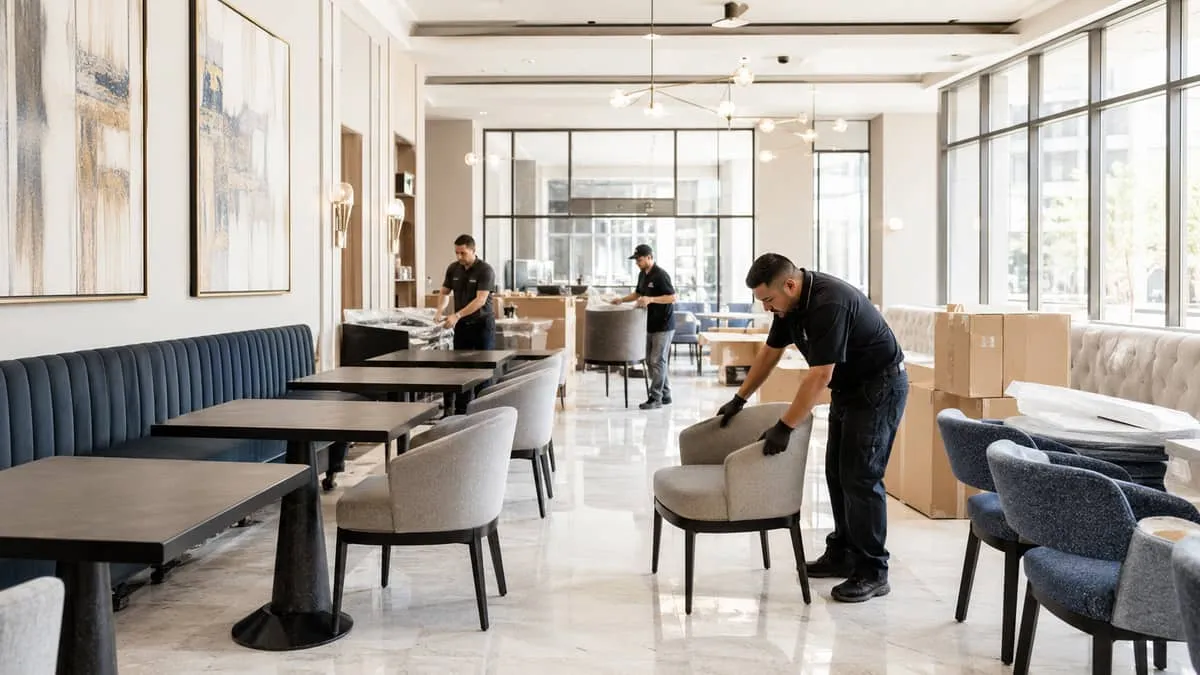
Inglewood's boutique hospitality operators, by contrast, tend to prioritize character and individuality over standardization. These are smaller properties where a 60-seat dining room is a significant fit-out, and the furniture choices contribute directly to the neighbourhood feel that draws the clientele. Procurement for Inglewood properties often involves a mix of contract furniture and custom or semi-custom pieces, which requires managing two different supplier tracks simultaneously.
What a Full FF&E Procurement Process Looks Like
For most Calgary projects, procurement follows a sequence that starts earlier than operators expect and requires more specific decision-making at the front end than most are prepared for.
The process begins with a furniture schedule: a detailed line-item list produced by the interior designer or design-build firm that specifies every FF&E item, its quantity, dimensions, finish, fabric, COM requirements, and required delivery date. Without a complete furniture schedule, supplier pricing is meaningless because there's nothing specific enough to price accurately.
Once the schedule is finalized, it goes to contract furniture suppliers for formal quotation. In Calgary, some operators work with local dealers who have established relationships with Canadian and US manufacturers and can manage the freight coordination that Alberta projects require. Others engage procurement management firms that centralize purchasing across multiple suppliers, handle receiving at a local warehouse, and coordinate installation scheduling. For large projects, the procurement management approach reduces the administrative burden significantly, but it adds a fee layer that smaller fit-outs may not justify.
Freight coordination deserves specific attention for Calgary projects. The city is further from major manufacturing centres than Toronto or Vancouver, and that distance shows up in transit times and freight costs. Canadian manufacturers in Ontario and Quebec are typically better positioned to serve Alberta on timeline than US manufacturers, because cross-border customs clearance adds unpredictable time even when it proceeds smoothly. When US product is specified, experienced procurement teams build a customs buffer of at least two weeks into the schedule, not as a contingency but as a base assumption.
Installation coordination is the final variable that Calgary operators frequently underestimate. Installation contractors who work with contract furniture know how to receive and inspect shipments, manage punch lists, and coordinate with the GC on site access during the final weeks before opening. During active development periods in Calgary, these contractors book out quickly. Confirming installation dates before furniture orders are placed, rather than after, is standard practice for any project with a firm opening deadline.
Patio Season and Outdoor Furniture Specification
Calgary's outdoor dining culture is genuine, and the patio seasons on 17th Avenue SW and in the Beltline run from May through September in most years. Chinook weather patterns mean that even late fall and early spring can produce days warm enough for outdoor service, and operators who have outdoor spaces use them aggressively when conditions allow.
Outdoor FF&E for Calgary requires specifications that account for UV exposure during long summer days, wind loading from chinook events, and temperature cycling that stresses furniture joints over time. Powder-coated aluminum frames with UV-stable fabrics are the standard specification for exposed patio applications. Wicker and rattan products that look appropriate for a Vancouver or Toronto patio don't hold up well through a Calgary winter if they're stored improperly or exposed to freeze-thaw cycling.
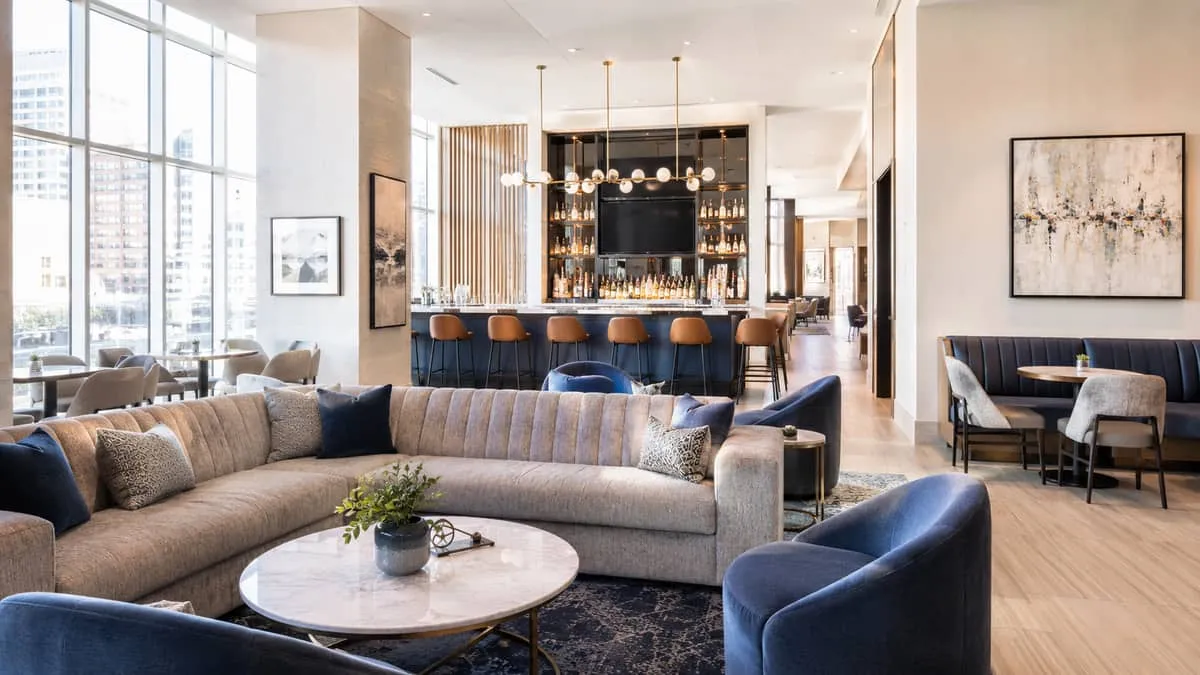
Stackability and storage matter more in Calgary than in milder climates. Patio furniture that can't stack efficiently takes up storage space that most urban restaurant operators can't spare, and furniture that requires complex seasonal storage procedures tends to be handled poorly, reducing its useful life. When specifying outdoor furniture for 17th Avenue or Inglewood patio programs, operators who have been through multiple seasons prioritize storage efficiency as a primary selection criterion alongside aesthetics and durability.
What Separates Effective Procurement from a Costly Delay
The Calgary operators who consistently execute FF&E procurement without opening date delays share a few common practices. They start the supplier conversation earlier than feels necessary, often six to eight months before target opening for any project with custom or semi-custom components. They treat the furniture schedule as a binding document rather than a working draft, because changes to specifications mid-production extend lead times and sometimes trigger full re-orders. They confirm freight and installation logistics before placing orders, not after. And they work with suppliers who have demonstrated experience delivering to Alberta on Calgary's timeline, not suppliers who treat Alberta projects the same as a Toronto suburb delivery.
The city's current development pace means there's no shortage of new properties coming to market. The ones that open on schedule and within budget are doing the same things they've always done: treating procurement as a project management discipline, maintaining supplier relationships between projects, and building enough lead time into their planning that a four-week delay in production doesn't become a missed Stampede season.
If you're working through a procurement process and want to understand more about what contract furniture means in a hospitality context, the guides below are a practical starting point.
For Calgary properties comparing FF&E options, project-specific pricing tells you more than any published range. Request a quote and we will scope it to your space and volume.