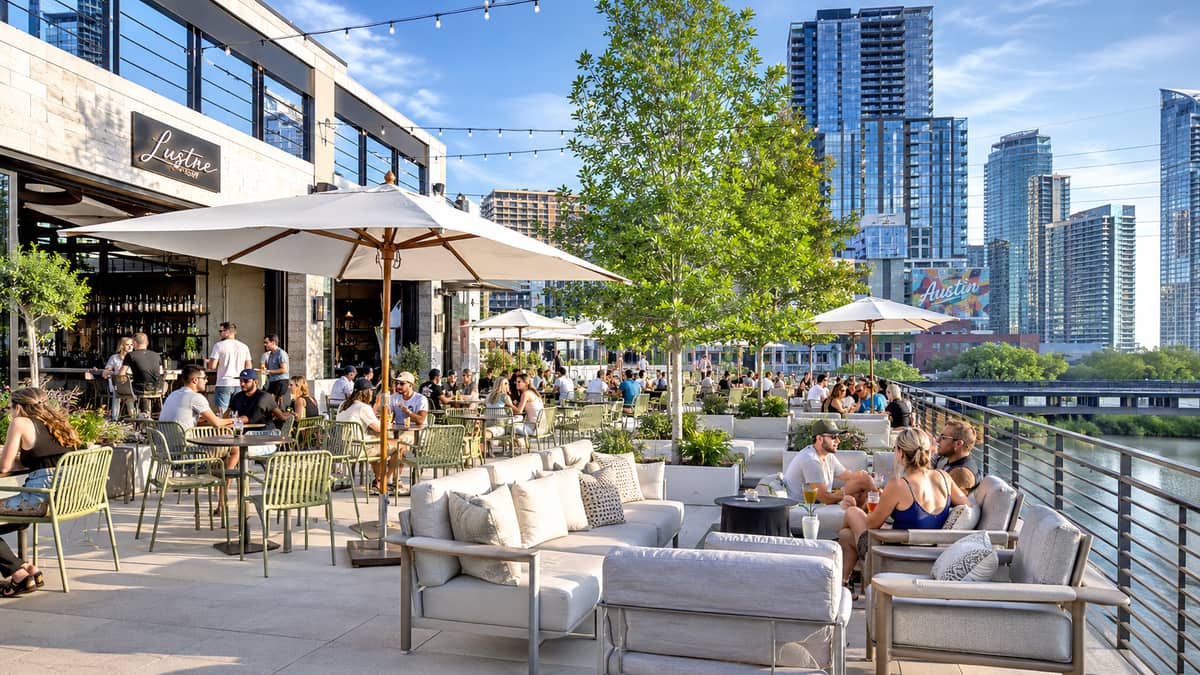
Newark has a patio problem that most furniture buyers underestimate until their first winter. The instinct when specifying commercial patio furniture in Newark is to focus on the summer season, since that's when outdoor seats actually generate revenue. But the operators running serious outdoor programs downtown near Military Park, along the Ironbound's restaurant corridor, and at the hotel properties serving Newark Liberty International Airport know that the furniture spends more of the year surviving than it does earning. Newark sits close enough to the water to pick up salt-laden air off Newark Bay and the Passaic River, far enough inland to get the full brunt of Nor'easters, and squarely in a climate band that cycles through freeze and thaw dozens of times a winter. That combination is harder on outdoor furniture than a straightforward cold-weather market or a straightforward warm one.
Operators who get this right treat patio and terrace furniture as a year-round capital asset with a defined lifecycle, not a seasonal purchase that gets put into storage in November and forgotten about until May. Getting the specification right up front is the difference between a program that holds its finish for eight years and one that shows corrosion at the welds by year three.
Newark's Climate Punishes the Wrong Assumptions
The common assumption is that a Northeast market like Newark is simpler to specify for than a Sun Belt city, since there's no relentless UV load to worry about. That assumption misses what actually degrades furniture here. Newark gets real winter, with sustained periods below freezing, several measurable snow events most seasons, and the kind of freeze-thaw cycling that is uniquely hard on powder coat and welded joints. Water gets into a hairline crack in a finish during a January thaw, refreezes overnight, and expands the crack a little further. Repeat that cycle fifteen or twenty times over a winter and a coating that looked fine in November is visibly compromised by March.
Then there's the coastal factor. Newark is not a beach town, but it sits at the head of Newark Bay, minutes from the harbor, and prevailing winds carry salt-laden air inland regularly enough that furniture specified without corrosion resistance in mind will show it. This matters most for any patio near the waterfront redevelopment along the Passaic River or for hotel properties close to the airport, where wind exposure is constant. A powder coat system without a proper zinc-rich primer or e-coat pretreatment underneath it is not sufficient for this market, regardless of how the topcoat is marketed.
Summer in Newark brings its own load: temperatures regularly reach the high 80s and low 90s, humidity climbs into the 70 to 80 percent range for stretches at a time, and afternoon thunderstorms are routine. That combination of heat and moisture is exactly the environment where mildew takes hold on cushion fabric that isn't rated for it, which is a real concern for the dense restaurant patio programs running along Ferry Street and the rest of the Ironbound through a full summer season.
What Downtown, the Ironbound, and the Waterfront Actually Require
Newark's patio market is not one market, and specifying furniture without matching it to the neighborhood's guest profile produces programs that function but feel out of place. Downtown, around Military Park, NJPAC, and the Prudential Center corridor, the outdoor seating serves office workers at lunch, event crowds before and after arena shows, and business travelers staying at the hotels that cluster around the transit hub. This is a market where furniture needs to look sharp under bright daylight and hold up under intense, concentrated bursts of traffic tied to event schedules rather than steady daily volume. Stackable dining chairs and modular tables that can be reconfigured quickly for a pre-show rush matter more here than in a market with predictable, even foot traffic.
The Ironbound is a different animal entirely. This is one of the most restaurant-dense corridors in New Jersey, built on Portuguese and Brazilian dining traditions where outdoor seating along Ferry Street and the surrounding blocks is a core part of the identity, not an add-on. The aesthetic here rewards warmth, texture, and a sense of permanence: darker wood-look aluminum frames, richer color in the cushion program, and a build quality that can survive a packed sidewalk patio running dinner service seven nights a week for a full season. Furniture that reads as generic hotel-catalog stock is a mismatch for a neighborhood built on family-run restaurants with decades of history.
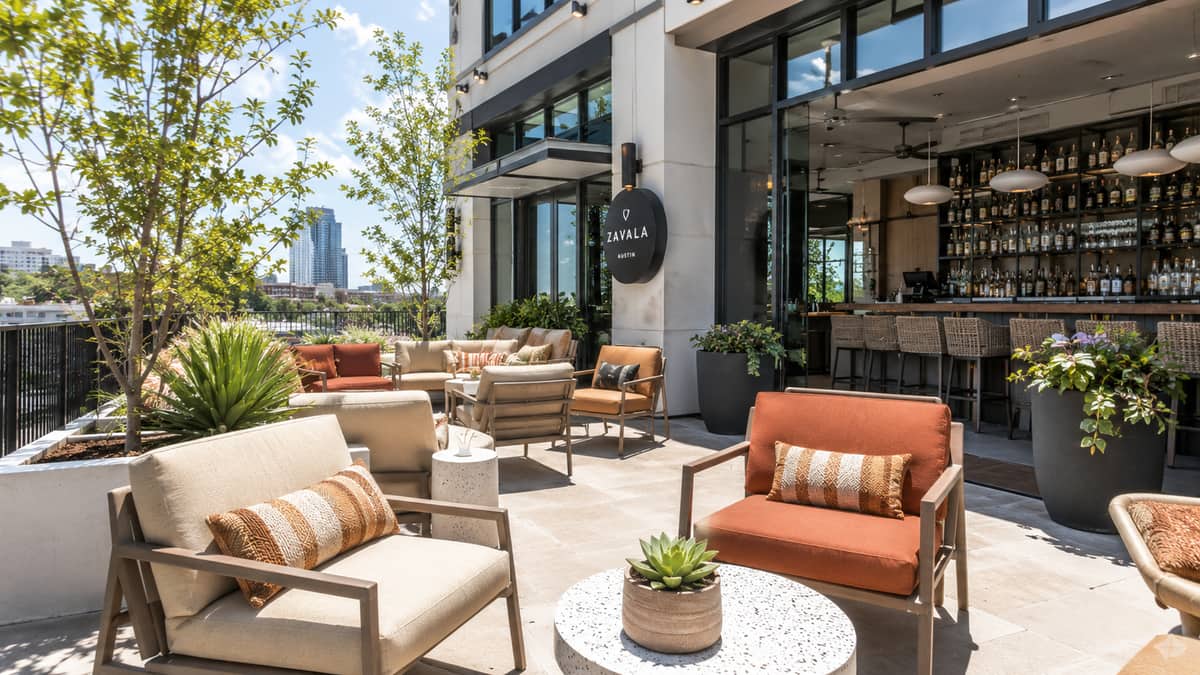
Then there's the airport hotel corridor along Route 1&9 and the properties serving business and layover travelers near Newark Liberty. This market runs on volume and turnover rather than design statement. Courtyards and pool decks here need furniture that can be cleaned quickly between high guest turnover, holds up to constant use with minimal downtime for maintenance, and still presents as a step above the budget furniture that undercuts brand standards at competing properties on the same strip.
Fabric, Foam, and Frame: Getting the Spec Right for a Northeast Climate
Fabric specification for Newark should start with solution-dyed acrylic, the same standard the industry uses everywhere, but the reasoning here is specifically about the freeze-thaw and humidity combination rather than pure UV load. Solution-dyed fiber holds its color and structural integrity through repeated wet-to-frozen-to-dry cycles in a way that surface-dyed fabric does not, and it cleans with a diluted bleach solution, which matters for mildew control during Newark's humid summer stretches.
Foam density is where a lot of Northeast patio programs quietly fail. Furniture that sits in storage for part of the winter and gets pulled back out in spring needs foam that hasn't lost its shape from cold compression. Commercial seating foam in the 2.0 to 2.5 lb density range with a proper ILD rating holds its profile through storage and through the humid stretch of a full Newark summer far better than the 1.8 lb foam that shows up in lower-grade programs.
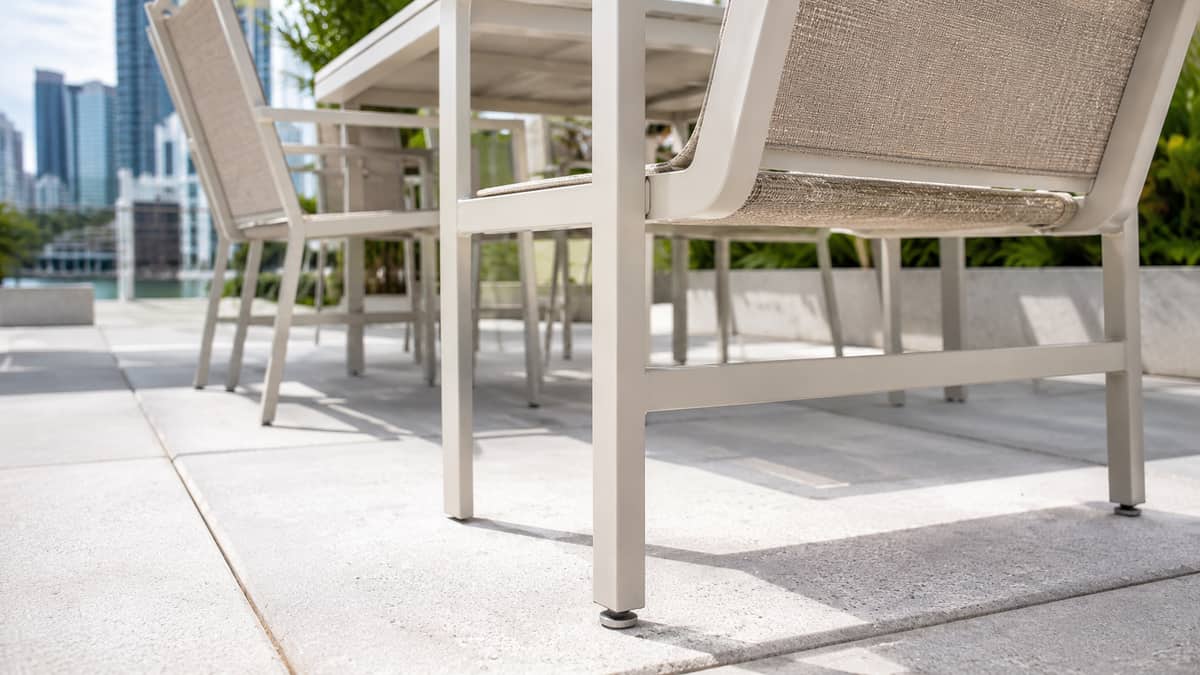
Frame material matters just as much. Commercial-grade aluminum at 1.5mm wall thickness minimum, with a full pretreatment process underneath the powder coat, is the right baseline for any Newark outdoor program near the water or exposed to winter road salt drift. Consumer-grade tubing in the 0.8mm to 1.0mm range simply does not hold up to a New Jersey freeze-thaw cycle repeated across multiple seasons, and the corrosion shows up at the welds first, which is exactly where it's hardest to repair.
The Revenue Math on Quality Commercial Patio Furniture in Newark
Newark benefits from steady, high-volume demand: a major international airport, a downtown arena and performing arts center that drive concentrated event traffic, and a restaurant scene in the Ironbound that runs at near-capacity most nights of the week. That demand only converts to revenue if the outdoor seats are usable and presentable across the full operating season, not just during a narrow summer window.
A properly specified commercial aluminum chair, maintained correctly, runs eight to ten years in active service even in a demanding Northeast climate. A lower-cost alternative that shows corrosion or fabric failure after two winters costs more over time once you account for replacement, the mismatch between old and new pieces on the same patio, and the lost revenue from seats that are out of service during a peak event weekend. Operators running hotel courtyards near the airport or restaurant patios in the Ironbound who have been through a few winters already know this math. They buy for the climate once and spend the following seasons maintaining rather than replacing.
The right approach to commercial patio furniture in Newark is to specify for the actual weather the furniture will face, match the design to the neighborhood it serves, and evaluate cost against the full lifecycle rather than the invoice on delivery day. Programs built this way become a durable part of the guest experience. The ones that skip this step end up rebuilding their patio program every few seasons instead of maintaining it.