Burlington has a patio problem, and it's not the one most operators plan for. The assumption walking into a Burlington furniture project is that the short Vermont season is the whole story: five or six good months, then storage. That's part of it, but the operators who have been running serious outdoor programs on Church Street Marketplace, along the Lake Champlain waterfront, and in the South End arts district know the real challenge is more layered. Commercial patio furniture in Burlington has to survive a genuine four-season climate that swings from ice storms and heavy snow load in the off months to a compressed, high-intensity stretch of lake humidity, strong UV off the water, and sudden temperature drops that can hit a September evening without warning.
The operators who get this right are not treating outdoor seating as a summer-only amenity that gets dragged out and packed away. They're treating it as a concentrated revenue window with specific durability, comfort, and aesthetic requirements that differ from what you'd spec for a longer-season market like Charlotte or Nashville. Getting the specification right from the start is the difference between a patio program that pays for itself across eight to ten seasons and one that needs a partial replacement after three.
Burlington's Climate Actually Requires More, Not Less
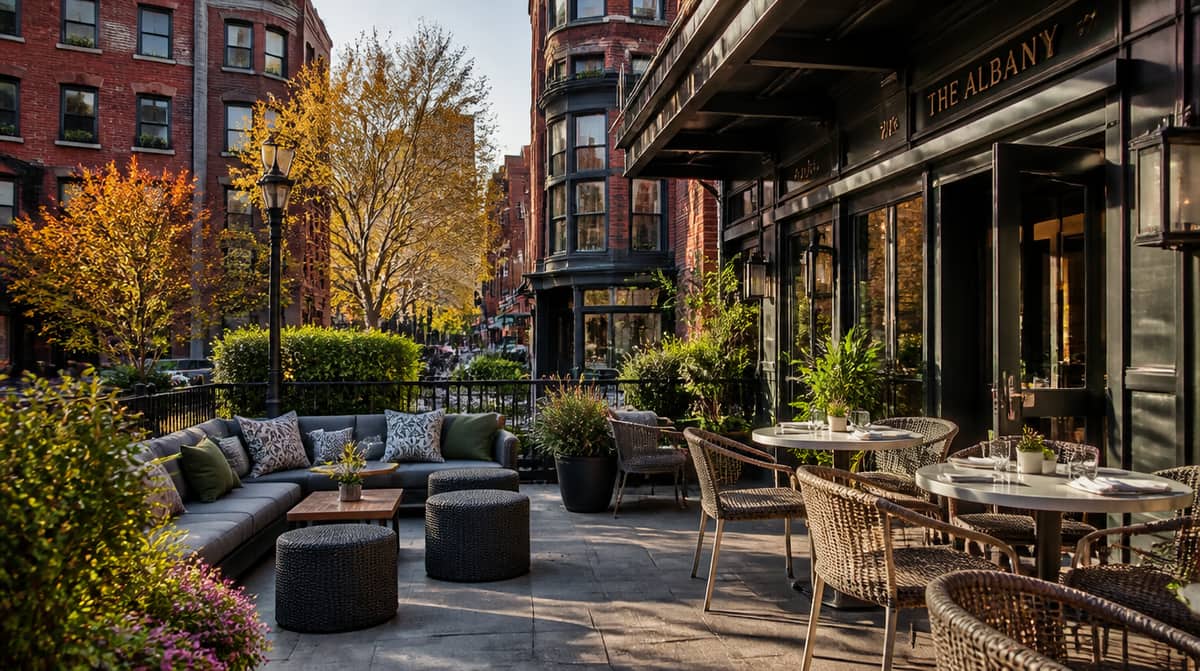
The standard industry logic runs like this: a shorter outdoor season means less wear, so furniture specs can be lighter. Burlington's climate says otherwise. Vermont winters bring real freeze-thaw cycling, moisture works into micro-cracks in a weak powder coat finish, freezes, expands, and accelerates delamination at weld points well before the furniture ever sees a guest again. Even furniture stored indoors for winter has to survive the shoulder-season swings in October and April, when a patio might be in full service one week and covered in frost the next. An operator who buys on the assumption that a short season means lighter-duty furniture learns otherwise the first spring the frames come back out.
Summer brings its own demands. Burlington sits directly on Lake Champlain, and UV exposure off open water is more intense than inland numbers suggest, particularly on west-facing waterfront patios that catch the full evening sun. The same powder coat finish that holds up for years in a shaded courtyard can show visible fading within two seasons on a waterfront deck if the topcoat's UV inhibitor concentration isn't specified and documented. "UV resistant" without a spec sheet behind it is not sufficient for a Lake Champlain-facing property.
Then there's humidity. Burlington summers, while shorter than a southern market's, run genuinely humid off the lake, with stretches where moisture sits on cushions and frames for days. That load accelerates corrosion anywhere the finish is compromised and creates mold conditions on fabrics that aren't rated for it. Properties near the Sheraton Burlington Hotel & Conference Center and the hotel corridor along Williston Road, which service steady convention and university-visitor traffic, know that fabric specification isn't optional. It's a maintenance line item that scales directly with how wrong the initial order goes.
What Church Street, the Waterfront, and the South End Actually Require
Burlington's patio market is not uniform. The design expectations at a Church Street Marketplace restaurant terrace differ from a Lake Champlain waterfront deck, and both differ from a South End brewery patio serving a younger, art-district crowd. Specifying commercial patio furniture in Burlington without matching the program to the location's guest profile is how operators end up with furniture that functions fine but reads as slightly off.
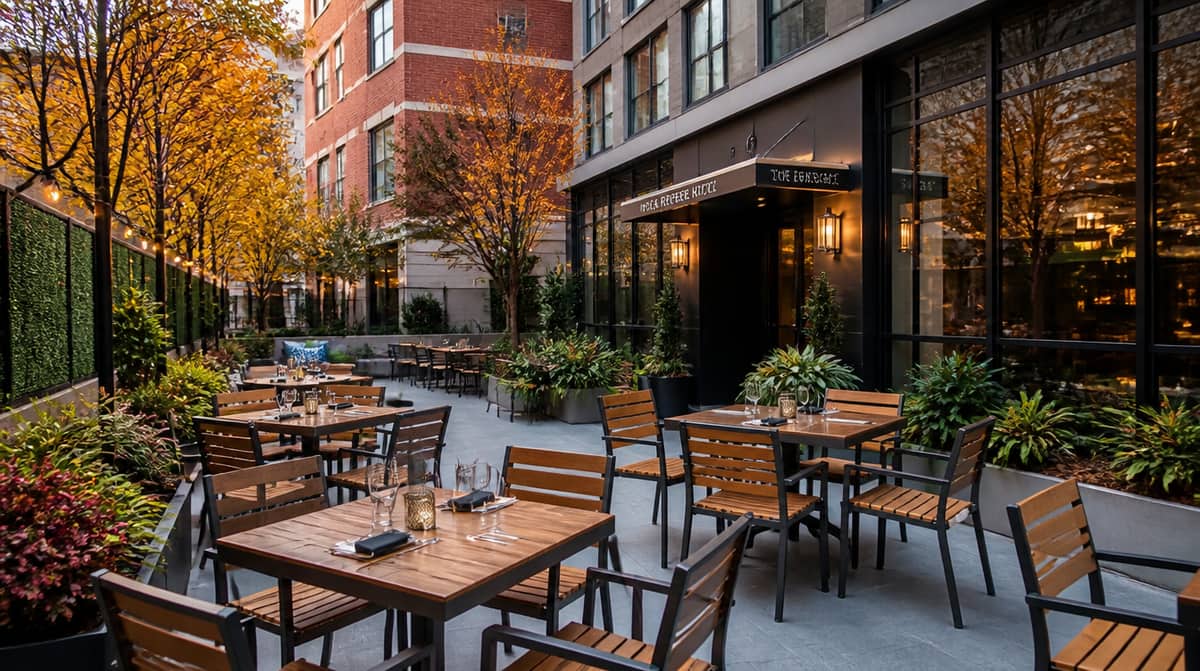
Church Street's pedestrian marketplace serves a mix of downtown professionals, university visitors, and tourists who expect a cohesive, walkable dining experience. Furniture programs here need to read as intentional from the sidewalk: matching frame finishes across dining chairs, bistro tables, and planters, with stackability that lets staff reconfigure quickly for the marketplace's frequent events and farmers market overlap. A Church Street patio mixing two frame programs because one arrived late reads as disorganized to a pedestrian crowd that has plenty of adjacent options to compare it against.
The waterfront corridor, from the Burlington Boathouse down through the harbor area hotels, operates on a different logic. These are high-visibility properties where the lake itself is the draw, and furniture needs to hold up against direct sun and wind off the water while still photographing well for the guests documenting their evening. Lighter frame finishes in a weathered aluminum or driftwood-toned powder coat tend to read better against the lake backdrop than a stark resort white, and shade structures need to be specified rather than improvised given how exposed most waterfront decks are.
The South End arts district and the breweries and restaurants along Pine Street reward a different aesthetic entirely: industrial, tactile, matte charcoal or bronze frames with visual weight, and seating that feels considered rather than catalog-ordered. This is also the highest-turnover segment of Burlington's patio market, so durability matters as much as look, since the guest volume here is relentless through the compressed season.
Cold, UV, and Fabric: Getting the Spec Right in Vermont
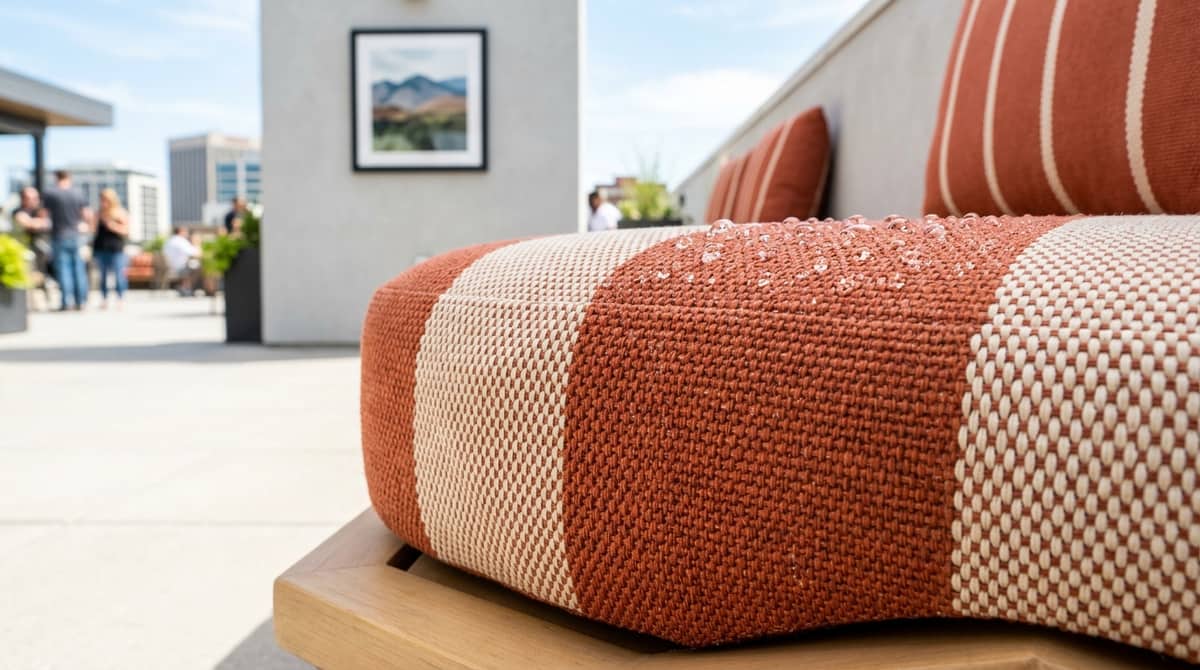
Fabric specification in Burlington deserves more attention than most operators give it before their first season. Solution-dyed acrylic, with Sunbrella as the industry benchmark, is the correct base for any uncovered or partially covered Burlington patio. The dye sits in the fiber itself rather than on the surface, which is why fade resistance holds up under lake-effect UV rather than washing out after a season or two the way surface-coated fabric does. It also cleans with diluted bleach, the right maintenance protocol for mold prevention in a humid climate, and it handles the cycle of a sudden afternoon rain followed by direct sun without the fiber breaking down.
Foam density is where many Burlington patio programs fail quietly. Standard 1.8 lb density foam compresses and loses its profile within a single compressed season of heavy hospitality use, particularly when a Church Street patio runs at full capacity through festival weekends and graduation traffic from the University of Vermont. Commercial seating foam in the 2.0 to 2.5 lb range with a higher ILD rating holds its shape through continuous rotation. The difference between a cushion that still feels right in September and one that's compressed flat by August is the foam spec on the purchase order, nothing more subtle than that.
For frame material, commercial-grade aluminum at 1.5mm wall thickness minimum is the right starting point for a Burlington hospitality application, particularly given the added stress of seasonal moving, storage, and re-deployment that a shorter season imposes on every piece. Consumer-grade frames in the 0.8mm to 1.0mm range work for occasional residential use. They do not hold up on a commercial patio where staff move chairs daily, guests lean back with full weight, and the furniture cycles between storage and active service every year. Weld quality at the joints matters as much as wall thickness, and it's worth asking suppliers directly about joint construction rather than judging quality by frame weight alone.
The Revenue Math on Quality Commercial Patio Furniture in Burlington
Burlington punches above its size as a hospitality market, with steady convention traffic through the Sheraton Burlington Hotel & Conference Center, a strong university-driven visitor base tied to the University of Vermont, and a waterfront and Church Street dining scene that draws regional tourism well beyond the ski season. Because the outdoor season is genuinely shorter than a southern or coastal market, every seat has fewer weeks to earn its return, which makes the lifecycle math on furniture quality more important, not less.
A commercial aluminum dining chair correctly specified for a Vermont climate, stored and maintained properly, lasts eight to ten years in active seasonal service. A consumer-grade or "commercial-style" chair bought at a lower upfront cost that needs replacement after two or three seasons costs more per year of actual use, and it adds the operational headache of sourcing replacements mid-season, managing the mismatch between old and new pieces, and doing it all again soon after. Operators who have run Burlington patio programs through multiple cycles buy quality once, store it correctly over the winter, and reupholster rather than replace when the frame is still sound.
For hotel properties along the waterfront and near the conference center, brand perception is part of the calculus too. A patio with furniture that shows rust, fading, or structural failure by its third spring signals to guests that the property doesn't invest in the outdoor experience it's selling. In a market where the lake view and the marketplace scene are the whole pitch, that signal carries real revenue consequences.
The right approach to commercial patio furniture in Burlington is to specify for the actual climate (freeze-thaw winters and lake-effect summers alike), match the aesthetic to the neighborhood's character, and buy for the full lifecycle rather than the opening season's cost. The patio programs that get this right become durable competitive advantages through every short, intense summer. The ones that don't spend their off-season budgets catching up.