Baltimore is a commercial furniture market that rewards suppliers who understand the city's specific character. The demand mix convention hotel blocks, healthcare-adjacent hospitality, working waterfront restaurant and bar concepts, boutique properties in historic neighborhoods, federal contractor extended stays requires a product range broad enough to serve all of it and a supplier capable of coordinating complex, multi-category procurement programs across compressed timelines. The commercial furniture decisions made for Baltimore properties are rarely simple catalog purchases. They're specification exercises with real operational and design stakes.
Baltimore's Commercial Furniture Market
The Baltimore Convention Center and its surrounding hotel corridor represent the city's highest-volume commercial furniture market. The properties in the Inner Harbor corridor convention-scale hotels running hundreds of keys, large ballroom capacities, and continuous food-and-beverage operations are in a constant cycle of replacement, renovation, and expansion. Their commercial furniture needs span every category: guestroom casegoods and upholstered seating, lobby and public area furniture, ballroom and event seating, restaurant and bar furniture, and outdoor terrace furniture.
Banquet chairs and dining chairs are the highest-volume replacement categories for Convention Center-adjacent properties. The pace of use in hotel ballrooms serving back-to-back conferences is continuous chairs are stacked, transported, set, used, and reset multiple times daily during peak convention periods. Commercial-grade frames with BIFMA-rated construction are the only appropriate specification for this use pattern. Residential or light-commercial grade furniture in a Baltimore convention hotel will not survive its first calendar year.
The healthcare and academic medical sector adds a significant commercial furniture demand segment that few other cities can match. Johns Hopkins Medicine and the University of Maryland Medical System are among Maryland's largest employers, and the facilities infrastructure that supports those systems patient family hotels, healthcare conference centers, medical education buildings, campus hospitality represents a consistent commercial furniture procurement pipeline. Commercial furniture in healthcare-adjacent settings needs to meet not just general commercial durability standards but healthcare-specific requirements: antimicrobial surface treatments, cleanability specifications, and in some contexts weight ratings that accommodate bariatric patients and family members.
Baltimore's restaurant and bar market particularly in Fells Point, Federal Hill, and the Inner Harbor waterfront runs at volumes that eliminate the false economy of lower-grade commercial furniture. A Fells Point bar running 300 covers a night needs barstools and dining chairs that can absorb that pace across a seven-night week, fifty weeks a year. The difference between a commercial-grade barstool and a light-commercial product shows up in the maintenance log within eighteen months, and the total cost of replacement cycles on the inferior product typically exceeds the upfront cost difference within two years.
The federal contractor and government-adjacent segment office and meeting furniture for Baltimore's federal agency footprint and D.C.-adjacent private contractor offices represents a distinct procurement category within the broader commercial furniture market. These buyers tend to work on General Services Administration schedule pricing or equivalent procurement frameworks, and they value consistent lead times and documentation compliance as much as product quality.
Baltimore Commercial Design Standards
Baltimore's commercial design aesthetic has cohered around a recognizable palette and material vocabulary over the past decade, and commercial furniture specifications that align with that vocabulary perform better across the board better guest and customer satisfaction, better online review scores, and better renovation ROI. The city's brick-and-harbor contemporary aesthetic warm wood, weathered steel, maritime industrial references, Chesapeake Bay color palette is not a trend borrowed from elsewhere. It's Baltimore's own design language, and commercial furniture that speaks it lands with authority.
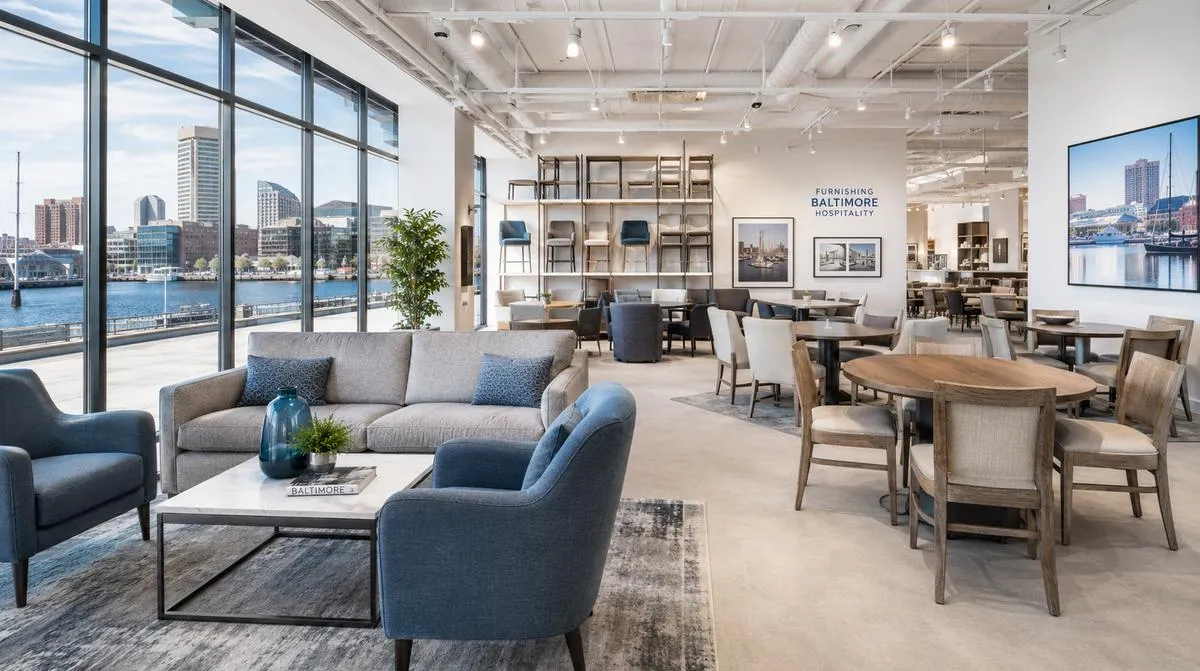
For hotel public areas, the specification hierarchy starts with sofas and lounge chairs as the room's visual anchors. Deep navy, slate blue, or warm charcoal upholstery on a mid-century-influenced frame in walnut or aged brass establishes the palette. Ottomans in a complementary cognac leather or textured linen provide texture contrast and flexible additional seating. The result is a room that reads as a specific place Baltimore rather than a generic hospitality environment.
For restaurant and bar contexts, the Baltimore commercial furniture aesthetic values authenticity over polish. Solid wood dining chairs with visible grain and a warm stain, metal barstools with a raw or flat-black frame finish, tables with reclaimed-look or butcher-block tops these specifications read as genuine rather than manufactured, which is the visual signal Baltimore's dining public responds to.
Supplier Selection and Procurement Coordination
Selecting a commercial furniture supplier for Baltimore hospitality projects requires evaluating four dimensions beyond price: product range adequate to cover multiple procurement categories in a single relationship; lead time transparency from specification through delivery; demonstrated experience with Baltimore's specific delivery logistics; and willingness to provide compliance documentation (fire safety, BIFMA, antimicrobial specs) as a standard part of the specification package.
Lead times across commercial furniture categories currently run six to eighteen weeks depending on specification complexity. Projects with custom upholstery, COM specifications, or non-standard dimensions sit at the longer end of that range. Coordinating multi-category procurement casegoods, seating, and event furniture for a full hotel renovation requires a supplier who can confirm production schedules across categories simultaneously, not sequentially.
Begin supplier conversations for Baltimore commercial furniture projects six to nine months before the target delivery date. This timeline creates room for specification review, material approval, production scheduling, and delivery coordination without compressing any phase.
Every Baltimore venue has its own volume, layout, and turnaround demands, and commercial furniture pricing follows from those specifics. Request a quote and we will scope it to your project.