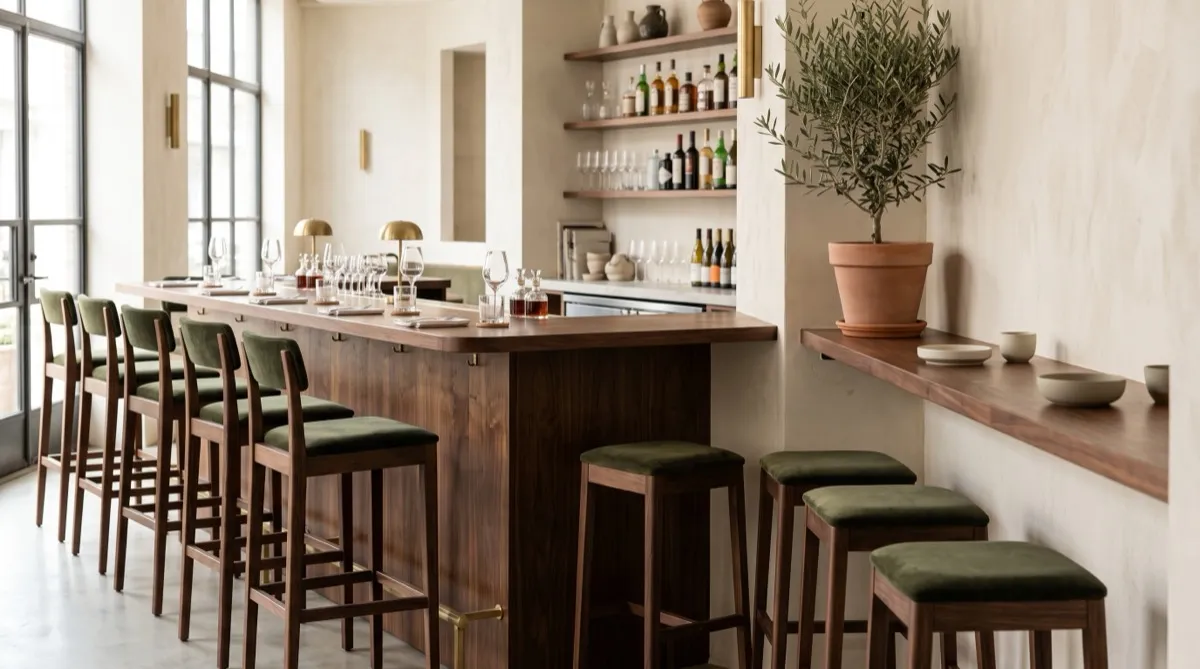
A pub table is not a poseur table that happens to be shorter. For this guide, it is a tall table assigned to a regular front-of-house zone; many pub tables are freestanding rather than bolted down, and it gets specified against a different set of demands than the fold-and-store rental tables covered elsewhere. If your room is a tavern, English-style pub, or any bar concept where the tall tables stay put through years of service rather than getting broken down after an event, this is the spec to follow.
Pub table versus reception poseur table: the split that matters
The bar height tables guide provides related event and reception planning. Specify whether the selected pub table must remain fixed, be moved for cleaning, or fold for storage; a pub or event label does not establish its mechanism or permanence. Obtain the model's intended-use, handling and assembly records for the actual task.
Base weight and footprint: the core spec question
A pub table's base does more work than almost any other component in the room. Compare the actual assembled base weight, footprint, column, top, and mounting details. Cast iron is not universally heavier than every steel or aluminum base, and material alone does not establish resistance to tipping. Obtain the maker's permitted top sizes and stability evidence for the selected table height. Compare 42 inch and 30 inch table-height examples using exact assembled stability records; height alone does not establish the forces applied by guests or authorize leaning on either table.
Base footprint diameter should scale with top size, not just top weight. A narrow trumpet-style base under a wide round top creates a tipping risk that isn't obvious until someone leans on the top's edge rather than its center. Do not approve a top/base pairing from a 55 to 60 percent diameter ratio. That unsupported rule does not account for top mass, column height, mounting, or base geometry. Use the maker's permitted top-size and weight limits for the exact base, and obtain confirmation of the assembled configuration.
Top-size-to-stool-count ratios
Sizing a pub table's top against its expected stool count avoids two common mistakes: tables too small for the party they're meant to seat, and tables oversized enough that guests can't reach a shared surface comfortably. For an illustrative layout comparison, try two positions at a 24 inch round top and three to four at a 30 to 36 inch round or square top. These are trial counts, not verified capacity or comfort promises; draw the chosen stools, footrests, tabletop service, and clear route, then test the sample arrangement. For a top larger than 36 inches, test reach, service and the exact stool arrangement; that dimension alone does not establish a communal-table classification or a better use.
Match stool count to table diameter conservatively. Overselling a small pub table as a four-top creates crowding at the base where stool footrests and legs compete for space, and that crowding is exactly the kind of friction that shows up in guest complaints without anyone naming the actual cause.
What table height works for a mixed pub and dining room?
Many pub concepts run both pub-height and standard dining-height seating in the same room, and mixing them without a plan is where the visual chaos starts. The fix is zoning, not uniformity. Keep pub-height tables clustered in a defined zone, near the bar or in a dedicated standing-and-perching section, rather than scattering them among standard dining tables. A room with pub height and dining height tables interspersed randomly reads as unplanned even when every individual table is well made. If you're deciding between the two for a given zone, our guide comparing bar height and counter height lays out the dimensional differences at greater length.
Wobble prevention on real floors
Check each intended table position for floor condition and level, then obtain the maker's permitted leveling method, glide adjustment and maintenance instructions. Test the exact top/base assembly in place. Adjustable glides are one possible design feature, not a universal requirement or a guaranteed lowest-cost cure for wobble.
Inspect the exact base-to-top connection, fasteners, tightening and maintenance procedure and any stability or lateral-load documentation. A bolted, clipped or friction-fit label does not establish years of performance or predict which connection will loosen; use the approved assembly and inspection instructions.
Sourcing and lead times
Confirm exact stock quantity, custom feasibility and delivery milestones for the proposed base and top. Ask whether they are supplied as one assembly or separate schedule lines, and obtain permitted pairing and finish documents. Common cast iron or custom labels do not establish faster fulfillment. Use 10 to 14 weeks only as an illustrative early assumption until the selected package's schedule is confirmed.
Use the restaurant seating capacity calculator for an area-based scenario, then draw the actual pub tables, stools, occupied clearances, and circulation. The calculator does not place the pub-height zone or confirm its fit within the full floor plan. Pub tables are one piece of a larger program alongside bar stools, booths, and dining seating; our restaurant furniture hub ties those pieces together. Browse table base concepts, then get a quote with the floor plan, top dimensions and weight, table height, and intended configuration. Ask responding suppliers for the exact base's permitted top size and mass, footprint, assembly and anchoring instructions, and relevant stability documentation; a category label does not approve a permanent installation.