Hotel FF&E procurement in Pittsburgh is not a simple logistics problem it's a design and operational challenge shaped by the city's unusual building stock, its genuinely distinctive aesthetic identity, and a hospitality market that spans everything from LEED-certified convention hotels to strip-district boutique conversions. Operators who treat FF&E procurement as a purchase order to be issued at the end of the design process consistently run into the same problems: lead times that don't fit construction schedules, specifications that don't match as-built conditions, and cost overruns that could have been avoided with earlier supplier engagement.
Pittsburgh's FF&E Market Dynamics
The David L. Lawrence Convention Center's sustained drawing power means Pittsburgh's full-service hotel market runs regular renovation cycles properties that compete for convention business have to update guest rooms and public spaces on a schedule that keeps pace with brand standards and guest expectations. For a 300-room full-service property cycling through a $4 million FF&E renovation, procurement logistics are as consequential as design decisions. Coordinating delivery against construction phasing, managing manufacturer lead times, and avoiding damage to installed finishes during furniture delivery all require a supplier relationship with real project management capability.
At the other end of the scale, Pittsburgh's boutique hotel sector clustered in Lawrenceville, the Strip District, and East Liberty presents FF&E procurement challenges specific to adaptive reuse: existing structural conditions that weren't built to hotel standards, irregular room dimensions that require custom or semi-custom furniture specifications, and building envelopes that complicate freight and installation access. A supplier who has not worked in adaptive-reuse Pittsburgh buildings before will encounter surprises that an experienced one has already solved.
The UPMC healthcare system one of the largest hospital networks in the United States generates consistent demand for extended-stay and limited-service hotel properties near its campuses in Oakland, Shadyside, and the South Side. These properties run high occupancy year-round, which means FF&E replacement cycles are compressed compared to properties with more typical occupancy patterns. Headboards, sofas, and case goods in these properties need to be specified for true extended-stay durability, not transient-market norms.
Carnegie Mellon University, Pitt, and the broader Schenley neighborhood academic corridor drives demand for limited-service properties that host visiting academics, prospective students, and conference attendees a guest profile that expects functional quality without necessarily demanding design distinction. FF&E procurement for these properties often prioritizes cost efficiency without sacrificing the durability that high-occupancy environments require.
Specification Strategy for Pittsburgh Properties
Pittsburgh's design identity imposes a positive constraint on FF&E specifications: the aesthetic vocabulary is clear, which makes specification decisions easier to anchor. Properties that try to import a generic national hotel aesthetic to Pittsburgh often find that the result reads as placeless and fails to differentiate in a market where differentiation is increasingly the competitive advantage.
For full-service properties, FF&E specifications should acknowledge the building's relationship to Pittsburgh's industrial history even within brand-standard frameworks. Headboards in dark wood veneers or steel-frame upholstered panels fit the market without requiring a full boutique design approach. Lobby lounge chairs in charcoal or warm neutral performance fabrics with metal bases connect to the streetscape without fighting brand guidelines.
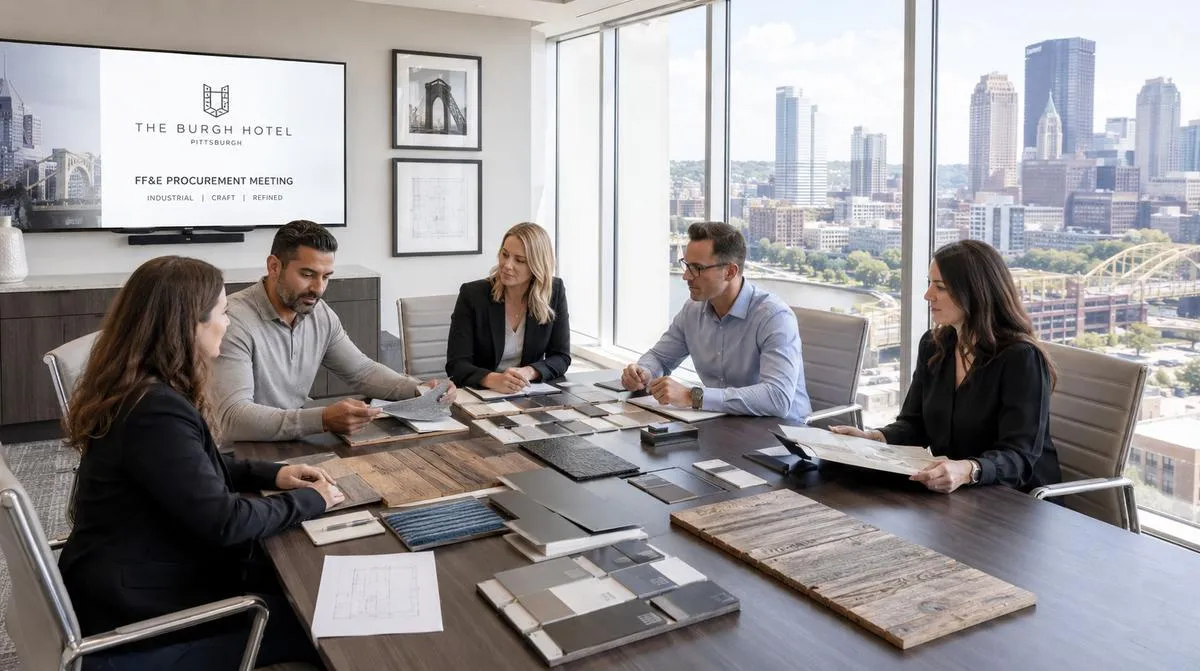
For boutique and independent properties, the specification latitude is wider and the design stakes are higher. FF&E packages should be developed in close collaboration with the design team from early schematic design furniture dimensions, material choices, and custom specifications need to be locked before construction drawings are issued, not after.
Guest room case goods in Pittsburgh's boutique market increasingly incorporate reclaimed or reclaimed-look materials a specification that requires working with suppliers who have established supply chains for these materials rather than scrambling to source them late in the project.
Procurement Process and Lead Times
Standard lead times for contract-grade hospitality FF&E run 10 to 16 weeks for manufactured pieces and 16 to 24 weeks for fully custom specifications. Pittsburgh projects with adaptive-reuse timelines which often run behind initial construction schedules due to historic preservation requirements or unforeseen structural conditions need FF&E procurement initiated early enough to absorb schedule slippage without delaying the opening.
A structured FF&E procurement process for a Pittsburgh hotel project should include: design specification lock 20 weeks before target opening, purchase order issuance 16 weeks out, delivery phasing coordination 8 weeks out, and installation scheduling in the final 4 weeks before opening. Properties that compress this timeline to 8 or 10 weeks total typically pay expediting premiums that eliminate any savings from late-stage value engineering.
Warehouse-hold programs where a supplier receives and holds furniture at a regional warehouse until the construction site is ready are worth negotiating for Pittsburgh adaptive-reuse projects where the delivery window is genuinely uncertain.
Every Pittsburgh venue has its own volume, layout, and turnaround demands, and FF&E pricing follows from those specifics. Request a quote and we will scope it to your project.