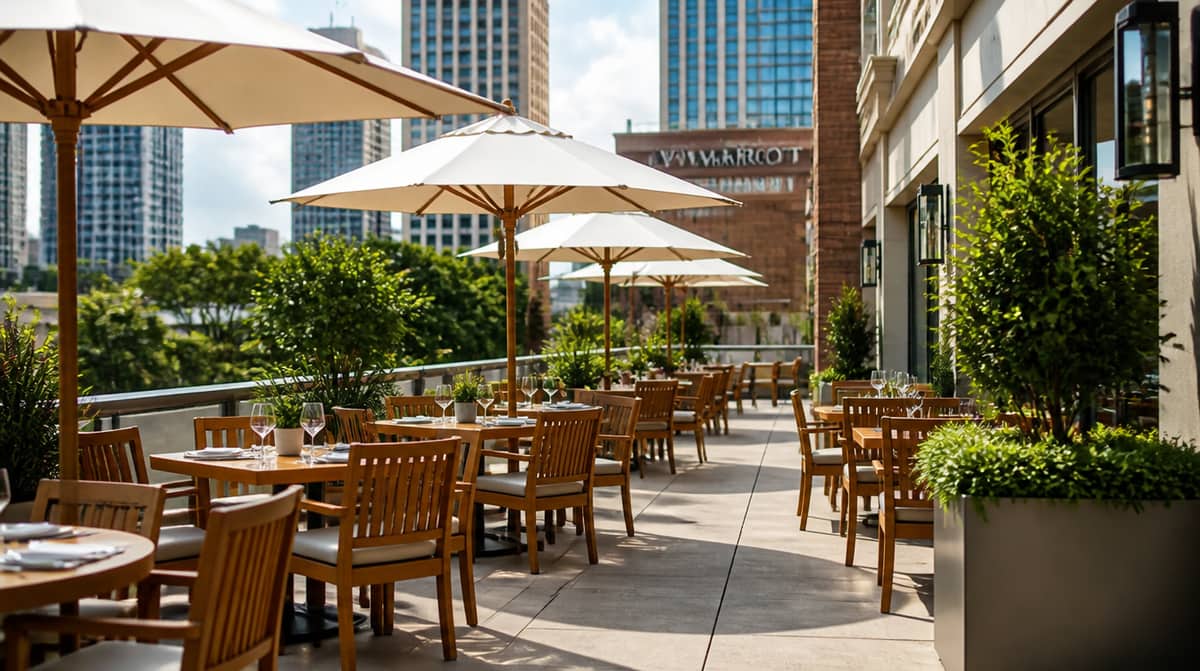
Providence has a patio problem that most out-of-town furniture reps never quite grasp. The assumption when a supplier walks into a Rhode Island project is that this is a short outdoor season, so furniture quality is a secondary concern behind price. The operators who have actually run patio programs through a full year on Federal Hill, along the Providence River, and up on the East Side near Brown and RISD know better. A Rhode Island patio has to survive raw, salt-laden air rolling in off Narragansett Bay, freeze-thaw cycles that hit metal furniture harder than a straight cold snap would, spring nor'easters that arrive with real wind loads, and a compressed but intense season where every warm weekend from May through October needs to generate revenue.
The operators who get commercial patio furniture in Providence right are not treating outdoor seating as a bonus amenity for the four warm months. They're treating it as a seasonal revenue engine that has to survive a genuinely harsh New England off-season in storage or in place, and that has to look sharp for a market that includes some of the most design-literate diners in the Northeast. Getting the specification right from the start is the difference between a patio program that pays for itself for a decade and one that needs a partial rebuild after its third winter.
Providence's Climate Punishes the Wrong Frame Choice
The standard assumption is that a compact New England outdoor season means furniture takes less abuse than it would in a year-round market. Providence's weather record says the opposite. The city sits directly on Narragansett Bay, and that proximity means salt-laden air moves through Federal Hill, the Jewelry District, and the Providence River corridor on a regular basis. Salt air accelerates corrosion at any point where a powder coat finish has a pinhole, a scratch, or a weak weld, and it does this faster than plain humidity would in an inland city.
Then there is the freeze-thaw cycle itself. Rhode Island winters swing repeatedly between freezing and thawing rather than settling into one long deep freeze, and that repeated expansion and contraction is exactly what finds the weak points in a cheap finish. An operator who stores furniture outdoors, wrapped, over a Providence winter and skipped the marine-grade powder coat spec typically discovers the mistake by the second March, when frames that looked fine in November show pitting and surface rust along the welds.
Humidity matters here too, just on a different schedule than a southern market. Providence summers run warm and genuinely humid, with stretches in July and August where moisture sits heavy over the river and the downtown core. That is exactly when WaterFire draws its biggest crowds and every restaurant with outdoor seating from Downcity to the Wickenden Street corridor is running at full capacity. Fabric and cushion specification has to hold up to that combination of heat, moisture, and constant guest turnover, or it becomes a line item on the maintenance budget by August.
What Federal Hill, Downcity, and the East Side Actually Require
Providence's patio market is not one market. The expectations on Federal Hill's Atwells Avenue restaurant row are different from a Downcity hotel terrace near the Rhode Island Convention Center, and both differ again from the cafe patios on the East Side near Brown University and RISD. Specifying commercial patio furniture in Providence without matching the program to the neighborhood's character is how operators end up with furniture that works fine but reads as slightly off to the guests who actually live there.
Federal Hill's restaurant corridor is built on generations of Italian dining tradition, and the outdoor seating along Atwells Avenue and DePasquale Plaza needs to read as an extension of that, not as a generic sidewalk cafe setup. Matte bronze or dark charcoal frames, substantial dining chairs with real weight to them, and tables that can handle close-set, high-turnover service all matter here. A Federal Hill restaurant that puts out lightweight resin furniture undercuts an otherwise serious dining room, and regulars notice.
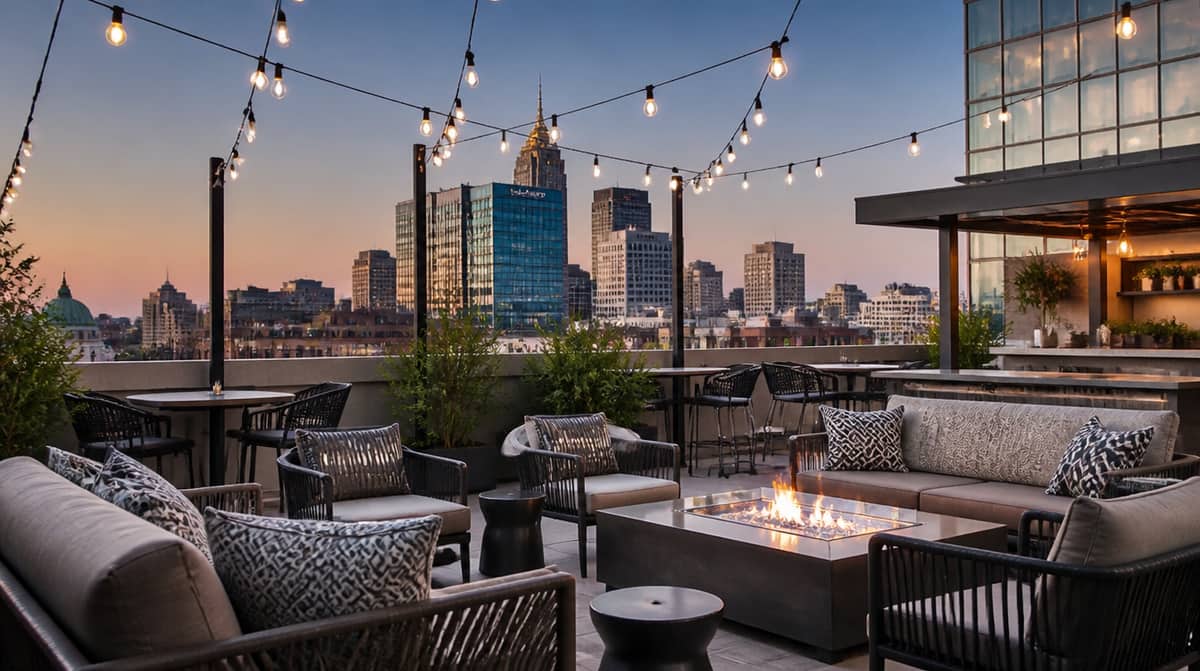
Downtown Providence, the Downcity area and the corridor near the convention center and the Dunkin' Donuts Center, runs on a different logic entirely. Hotel terraces and restaurants here serve a mix of convention traffic, business travelers, and WaterFire crowds that can triple foot traffic on a lit weekend. Furniture in this zone needs to stack and reconfigure quickly for private events, hold up under sustained high-volume service, and still photograph well against the river and the gas braziers that draw people downtown in the first place.
The East Side, around Thayer Street and the university corridors, rewards a more relaxed, collegiate aesthetic. Cafes and casual restaurants serving students and faculty do better with lighter frame finishes, mixed seating heights, and a program that feels approachable rather than formal. Overbuilding a resort-style program here often reads as mismatched to the neighborhood the way an overly casual set would look wrong on Federal Hill.
Fabric, Foam, and Frame Specs for a New England Coastal Climate
Solution-dyed acrylic remains the correct base fabric specification for any Providence patio with regular sun and rain exposure, with Sunbrella as the industry benchmark. Because the color is embedded in the fiber rather than applied to the surface, it holds up through the freeze-thaw storage cycle and the summer humidity spike without the surface fading or the fiber breaking down the way lower-grade outdoor fabrics do after two Rhode Island seasons.
Foam density is where a lot of Providence patio programs quietly underperform. Standard 1.8 lb density foam compresses fast under the kind of concentrated summer traffic a WaterFire weekend or a busy Federal Hill Saturday generates. Commercial-grade foam in the 2.0 to 2.5 lb range holds its profile through a full season of nights when every seat turns over multiple times.
Frame material needs to account for both the salt air and the freeze-thaw exposure specific to this market. Commercial-grade aluminum at 1.5mm wall thickness minimum, with a marine-rated powder coat process, is the right baseline for a Providence hospitality application. Consumer-grade frames in the 0.8mm to 1.0mm range, even when marketed as "commercial style," typically show corrosion at the welds within two winters near the water.
The Revenue Math on Quality Patio Furniture in Providence
Providence packs a compressed but intense outdoor season into roughly six months, and the hotels and restaurants around the convention center, downtown, and the WaterFire route depend on that window to carry a meaningful share of annual outdoor revenue. A well-positioned Downcity terrace on a WaterFire night generates significant per-seat revenue in a single evening, and that math changes entirely when furniture quality is measured against that concentrated revenue rather than against sticker price.
A properly specified commercial aluminum chair, maintained and stored correctly between seasons, lasts eight to ten years in a Rhode Island climate. A lower-cost alternative that needs replacement after two or three winters costs more annually once you account for replacement, mismatched aesthetics between old and new pieces, and the operational disruption of resourcing mid-season. Operators who have run Federal Hill and Downcity patio programs across multiple years buy for the full lifecycle once and reupholster rather than replace when the frame is still sound.
The right approach to commercial patio furniture in Providence is to specify for salt air and freeze-thaw durability, match the aesthetic to the neighborhood's character, and buy for the long season rather than the short one. The programs that get this right turn a compressed New England outdoor season into a durable competitive advantage year after year.