Pittsburgh's commercial furniture market has diversified significantly alongside the city's economic transformation. A decade ago, commercial furniture demand in Pittsburgh was concentrated in healthcare (UPMC and its affiliates), higher education (CMU and Pitt), and a relatively conventional downtown office and hotel market. Today, the city's commercial furniture needs span tech-sector office fitouts for Google, Uber ATG, and Duolingo's Pittsburgh operations; boutique hotel and restaurant projects in Lawrenceville and the Strip District; convention-adjacent hospitality for the David L. Lawrence Convention Center; and a growing private sector that has followed the talent Carnegie Mellon continues to produce. Finding a supplier who can serve this full range with genuine competence across categories rather than a hospitality specialty that excludes everything else is worth the search.
Pittsburgh's Commercial Furniture Demand Sectors
The tech sector is Pittsburgh's fastest-growing commercial furniture market. Google's Pittsburgh office, Uber's Advanced Technologies Group, Duolingo's headquarters, and dozens of CMU-adjacent startups have created demand for workplace furniture that reflects the expectations of a workforce recruited from some of the most design-sophisticated workplaces in the country. These companies don't specify generic contract workstation furniture they want environments that communicate culture and attract talent. Lounge furniture in collaborative zones, flexible seating in all-hands spaces, and hospitality-quality furnishings in reception areas are all part of the commercial specification for Pittsburgh tech employers.
UPMC is Pennsylvania's largest employer and one of the largest hospital systems in the United States. Its facilities in Oakland, Shadyside, the South Side, and across the metro region generate consistent commercial furniture demand across a range of categories: patient family waiting areas, clinical staff lounges, administrative offices, training facilities, and the hospitality-adjacent spaces hotel partnerships, executive dining that a healthcare system of UPMC's scale develops alongside its clinical infrastructure. Commercial suppliers serving UPMC need to navigate healthcare procurement processes, meet infection-control material standards for clinical-adjacent applications, and maintain the delivery consistency that a healthcare operator requires.
Carnegie Mellon and the University of Pittsburgh together anchor a major higher education furniture market. Student union spaces, research facility lounges, faculty offices, and conference rooms all represent commercial furniture categories that the universities refresh on regular renovation cycles. CMU's robotics and AI facilities some of the most prominent in the world have attracted significant capital investment in facility upgrades that include commercial furniture specifications.
The hospitality sector hotel, restaurant, bar, and event venue is the most visible commercial furniture market in Pittsburgh's current growth moment. Properties in Lawrenceville, the Strip District, East Liberty, Downtown, and the North Shore are opening and renovating at a pace that reflects the city's positioning as a genuine leisure and business travel destination. Dining chairs, lounge chairs, barstools, banquet chairs, and sofas the full range of hospitality seating categories are in consistent demand from operators who need contract-grade durability and design credibility in equal measure.
Design Consistency Across Commercial Categories
One of the practical advantages of working with a supplier who serves multiple commercial categories is design consistency across a mixed-use development or a multi-venue hospitality portfolio. A management company operating three Pittsburgh hotel properties, a restaurant, and event space benefits from furniture specifications that maintain a coherent design language across venues consistent frame finishes, compatible material palettes, coordinated upholstery families without requiring each property to source independently.
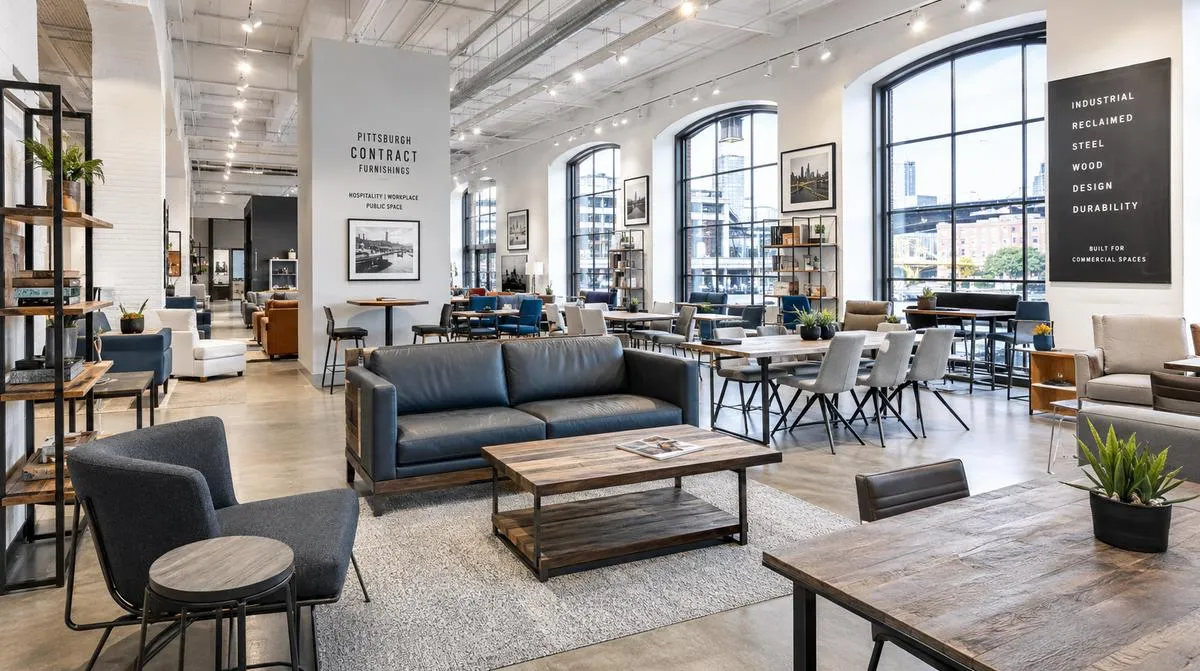
Pittsburgh's commercial design aesthetic provides a useful framework for this kind of portfolio consistency. The industrial-craft vocabulary black metal frames, reclaimed wood surfaces, performance fabric in dark and warm neutral tones translates across hotel lobby, restaurant, bar, and corporate office applications without feeling forced or repetitive. A supplier with depth across these categories can help develop a specification framework that scales across a portfolio rather than requiring fresh design decisions for each individual project.
Sofas and lounge chairs specified for a hotel lobby should relate visually to dining chairs in an adjacent restaurant not identical, but coherent. Barstools in a hotel bar should speak the same design language as the banquet seating in the property's event space. Achieving this level of design consistency requires a supplier relationship rather than a transactional vendor approach.
Procurement and Regional Service
Commercial furniture procurement for Pittsburgh projects should account for regional logistics realities. The city's geography river valleys, steep neighborhood grades, bridge weight limits, and older building stock with elevator and loading dock limitations creates freight and installation complexity that suppliers without Pittsburgh experience consistently underestimate.
Regional warehousing capability matters for large commercial projects: the ability to receive a full building's furniture order and phase delivery against construction completion avoids the storage burden on-site and reduces installation damage risk. Suppliers with established regional operations in western Pennsylvania can provide this service more reliably than those managing Pittsburgh deliveries as exception logistics.
Lead times vary by category: hospitality seating at 8 to 12 weeks, custom case goods at 14 to 20 weeks, upholstered pieces with custom specifications at 12 to 16 weeks. Commercial projects in Pittsburgh with fixed opening dates a hotel aiming for a Steelers season opening, a restaurant targeting the fall CMU move-in surge need procurement timelines built backward from the opening, not forward from a convenient procurement start date.
For Pittsburgh properties comparing commercial furniture options, project-specific pricing tells you more than any published range. Request a quote and we will scope it to your space and volume.