Milwaukee's commercial furniture market spans a wider range of venue types than its population might suggest. The city's unique combination of major sports and entertainment infrastructure, one of the world's largest music festivals, a growing convention market, a nationally recognized craft beer and restaurant scene, and a significant corporate services economy creates demand across every commercial furniture category simultaneously. Finding a commercial furniture supplier who can serve all of those contexts not just one segment with genuine contract-grade product and relevant design knowledge is the operational foundation that keeps Milwaukee hospitality properties competitive.
Milwaukee's Commercial Furniture Demand Landscape
The Deer District ecosystem surrounding Fiserv Forum represents one of the most concentrated commercial furniture demand environments in the Midwest. Hotels, restaurants, bars, and event venues within walking distance of the arena serve a guest base that includes NBA season ticket holders who visit 40 times per year, out-of-town sports tourists arriving for playoff series, and Milwaukee residents who treat the arena district as a regular entertainment destination. The furniture in that ecosystem takes year-round commercial-grade punishment, and operators who specified residential or light-commercial product when the district developed are now replacing it ahead of schedule.
Historic Third Ward's hospitality density boutique hotels, chef-driven restaurants, cocktail bars, private event spaces, and a growing corporate campus presence generates demand for commercial furniture that balances design authenticity with operational performance. Dining chairs and barstools in Third Ward venues are part of the brand proposition, not just functional elements which means a commercial furniture supplier serving this market needs product with genuine design credibility alongside commercial specs, not just catalog depth.
The Wisconsin Center and its surrounding hotel corridor produce steady demand for banquet, meeting room, and public space furniture at the volume that large-format convention operations require. A hotel property serving a 2,000-person convention needs banquet chairs in quantities that most local suppliers don't stock, delivered on a schedule that fits a predetermined event setup window, in a condition that makes the ballroom look professionally appointed rather than assembled from whatever was in the storage room.
Milwaukee's healthcare and financial services corporate market adds office and corporate hospitality furniture to the mix waiting areas, executive dining, conference rooms, and client reception spaces that draw from the same contract-grade product catalog as hospitality projects but with different specification priorities. A commercial furniture supplier with depth across both hospitality and corporate office categories can serve the full Milwaukee market.
What Contract-Grade Actually Means in Milwaukee's Context
The term "commercial grade" is used loosely in furniture sales, and Milwaukee operators benefit from understanding what the specifications actually mean. Contract-grade furniture, properly specified, is manufactured to standards that residential and light-commercial furniture doesn't meet.
For seating, contract grade means foam density rated at 1.8 pounds per cubic foot or higher, fabric rated at 100,000 double rubs or above using the Wyzenbeek test method, and frame construction whether wood or steel that carries a warranty under commercial use conditions. Lounge chairs sold into hotel lobbies need to sustain thousands of guest cycles per year without losing cushion shape or developing joint wobble. Sofas in public spaces should be built with spring systems and frame joinery that won't fail under the lateral stress that real-world hotel use creates.
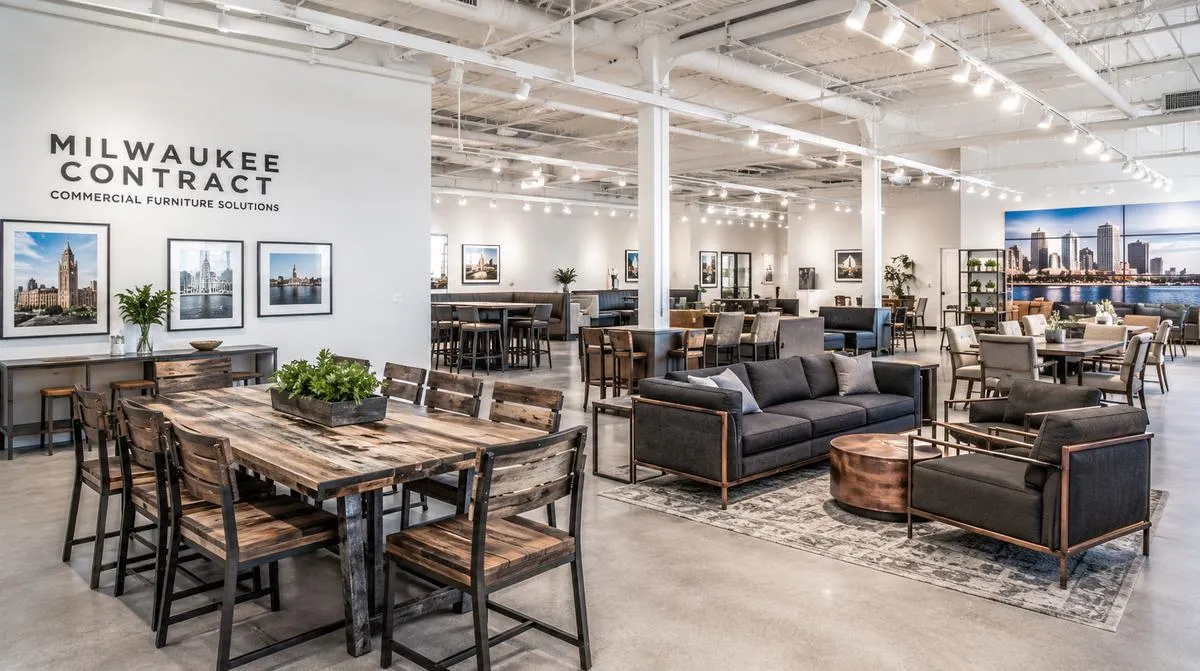
For case goods nightstands, dressers, desks contract grade means drawer construction with dovetail or box joint joinery, full-extension undermount slides with soft-close dampers, and veneer or solid wood surfaces applied over substrates that can sustain humidity variation without delaminating. Milwaukee's proximity to Lake Michigan creates seasonal humidity swings that accelerate failure in case goods not built to hold dimensional stability.
The commercial furniture suppliers who serve Milwaukee's market well maintain this specification discipline across their catalog rather than offering a mix of genuine contract pieces and residential-grade product sold under commercial marketing language. Vetting suppliers on the specifics foam densities, rub counts, frame construction methods, warranty terms under commercial use distinguishes suppliers who can support a Milwaukee hospitality project from those who can only sell to it.
Evaluating and Selecting a Commercial Furniture Supplier
Milwaukee operators selecting a commercial furniture supplier should evaluate on several dimensions beyond price. Product range and specification depth matter a supplier who can source headboards, dining chairs, barstools, banquet chairs, lounge chairs, and case goods from a single relationship reduces the coordination overhead of managing multiple vendor relationships across a renovation or new installation project.
Midwest logistics capability is the second criterion. A supplier with warehouse capacity in the Midwest region can receive and hold product between delivery and installation which matters in Milwaukee's calendar-constrained market where the delivery window and the installation window aren't always the same date. Suppliers who ship direct from manufacturer without regional staging capability create logistical problems that compound when Milwaukee's event calendar closes the installation window before product arrives.
Design support capability is the third factor, especially for Milwaukee's boutique and independent operator segment. Suppliers who can translate a client's design intent industrial-lakeside contemporary, reclaimed brewery wood aesthetic, Lake Michigan palette into specific product recommendations save operators the time and risk of specifying blindly from a catalog. This is the difference between a transactional vendor relationship and a supply partnership that produces better outcomes over multiple projects.
For Milwaukee properties comparing commercial furniture options, project-specific pricing tells you more than any published range. Request a quote and we will scope it to your space and volume.