Louisville's commercial furniture market is broader and more demanding than the city's size might suggest. The Kentucky Derby alone would justify a sophisticated local supply chain the hotels, restaurants, event venues, and entertainment facilities that activate during Derby Week constitute one of the most concentrated hospitality economies in America. Add Humana and Kindred Healthcare's corporate headquarters, UofL Health's expanding campus facilities, the Louisville Convention Center's year-round event calendar, and the bourbon trail's rapidly growing hospitality infrastructure, and you have a commercial furniture market with real scale and real standards.
Louisville's Commercial Furniture Demand by Sector
The hospitality sector is the most visible and design-intensive commercial furniture category in Louisville, and the Derby drives its specifications upward. Hotels near Churchill Downs and in the downtown corridor compete for a guest base that includes high-net-worth Derby attendees, bourbon tourism visitors with strong aesthetic preferences, and corporate travelers attending healthcare industry events. These buyers select commercial furniture that supports premium pricing and they're increasingly sophisticated about what contract-grade quality means and why it matters.
The bourbon tourism infrastructure has created a commercial furniture category nearly unique to Louisville: distillery tasting rooms, whiskey bars, and bourbon-focused restaurants that are essentially experiential retail environments. These spaces require furniture with specific material attributes the warmth and authenticity of real leather or wood rather than synthetic substitutes, the durability to handle tourist volumes, and the visual coherence to serve as backdrop for the inevitable social media content. Barstools and lounge chairs in this category are some of the most carefully specified commercial furniture purchases in the city.
Healthcare corporate environments Humana's sprawling campus on East Main Street, Kindred Healthcare's headquarters, UofL Health's administrative and clinical facilities constitute a major segment of Louisville's commercial furniture demand that has nothing to do with bourbon or horse racing. These buyers prioritize ergonomic performance, cleanability (healthcare environments have strict infection control requirements for any furniture entering clinical-adjacent spaces), and durability over multi-year replacement cycles. Contract-grade seating, modular workstation components, and healthcare-specific lounge and waiting room furniture are distinct product categories with distinct spec requirements.
The food service sector from NuLu restaurant buildouts to the hotel F&B operations that anchor the Convention Center corridor rounds out Louisville's commercial furniture picture. Dining chairs and banquet chairs in restaurant and event applications must meet the durability thresholds that high-volume service environments require, while also carrying the design sensibility that Louisville's elevated restaurant culture demands.
Design Standards Across Louisville's Commercial Market
Louisville's commercial design vocabulary has enough internal consistency that a supplier familiar with the market can anticipate specification direction across property types. The Kentucky heritage palette dark woods, warm leather tones, jewel colors runs through the hospitality sector as a unifying thread, even as individual properties put their own interpretation on it.
For corporate environments, Louisville's design culture is more conventional: contemporary finishes, neutral upholstery palettes, and ergonomic function over aesthetic statement. But even in corporate applications near the Humana and Kindred campuses, there's enough regional design consciousness that generic, cost-first specifications are increasingly rare among owners who care about employee and visitor experience.
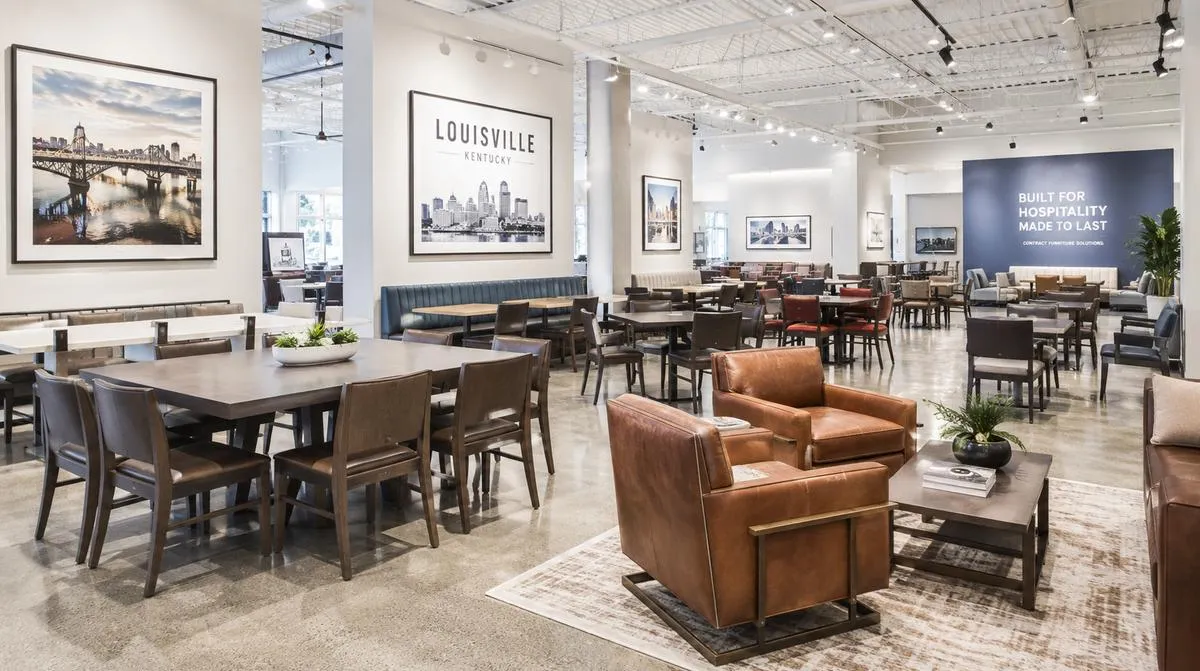
The NuLu commercial corridor restaurants, creative offices, boutique retail with adjacent café seating runs contemporary with warm accents, the urban-industrial material vocabulary translated into welcoming rather than cold. Dining chairs and lounge chairs in this neighborhood lean lighter in frame and more textile-forward in upholstery than the heavier, leather-dominant aesthetic of Whiskey Row.
Regardless of sector and aesthetic direction, Louisville commercial furniture buyers share a set of minimum expectations: commercial-grade construction (frame joinery, suspension systems, upholstery ratings), supplier experience with large-scale project coordination, and delivery capability that accounts for Louisville's Derby-driven calendar constraints.
Supplier Selection and Procurement for Louisville Projects
A commercial furniture supplier serving Louisville's full market needs logistics capability beyond just product range. The city's geography is favorable at the intersection of I-64, I-65, and I-71, Louisville is accessible from most major Midwest and Southeast distribution points without the freight complications that affect coastal markets. But the Derby timeline is a Louisville-specific constraint that suppliers unfamiliar with the market consistently underestimate.
Projects with any hospitality component need to be planned with a mid-April installation completion target and purchase orders placed with enough lead time to meet that deadline: 14-18 weeks for custom programs, 6-8 weeks minimum for stocked programs with large quantity requirements.
For healthcare and corporate projects without the Derby constraint, standard commercial furniture lead times apply. The key is identifying whether a supplier has experience with healthcare-specific specifications cleanability requirements, anti-microbial fabric options, weight-rated construction for bariatric applications before committing to a product program.
We quote commercial furniture for Louisville operators against their own layouts and order sizes rather than a generic sheet. Request a quote and we will put together pricing for your property.
Related reading
- Banquet tables in Louisville: sizing and specs
- What is contract furniture
- Hotel furniture supplier guide
- Hospitality furniture supplier guide
- Barstools for commercial bars and restaurants
- Commercial dining chairs for restaurants and cafeterias
- Banquet chairs for event and conference venues
- Commercial furniture in Kentucky