Louisville's boutique hotel market is one of the most interesting in the mid-South, precisely because the city gives operators so much to work with: a genuine design heritage rooted in thoroughbred racing and bourbon craft, a neighborhood in NuLu that rewards creative risk-taking, and a guest base that includes bourbon trail travelers, Derby pilgrims, and corporate visitors each arriving with distinct expectations. The boutique hotels that succeed here build furniture programs that speak to all of them.
NuLu and Whiskey Row: Louisville's Boutique Hotel Districts
NuLu New Louisville, centered on East Market Street has emerged as the city's most fertile ground for boutique hospitality. The neighborhood's combination of renovated industrial buildings, chef-driven restaurants, and independent retail creates exactly the environment boutique travelers seek. Properties here compete on design and curation rather than brand recognition, which puts furniture at the center of the guest experience in ways that branded hotels rarely face.
The NuLu boutique aesthetic leans contemporary and textural: exposed brick and ductwork paired with warm wood furniture, metal-framed lounge chairs in leather or performance wovens, and lighting that creates intimacy rather than broadcasting brightness. Guest rooms in this segment often use furniture to do design heavy-lifting that a limited renovation budget can't accomplish with architecture alone a well-chosen upholstered headboard or a distinctive side chair transforms a modest room into something memorable.
West Main Street and Whiskey Row anchor a different boutique hotel sensibility, one more directly connected to Louisville's bourbon and racing heritage. The 21c Museum Hotel and properties along the West Main Street corridor have established a sophisticated template: art-forward, material-rich, formal enough for the Derby crowd but contemporary enough to avoid feeling museumified. Sofas and lounge seating in these lobbies tend toward deep jewel tones emerald, sapphire, burgundy in velvet or textured wovens over solid upholstered frames.
Both districts require contract-grade construction. Derby Week doesn't care how beautiful your furniture is it will test its durability. Double-doweled frames, commercial-rated upholstery fabrics (50,000+ rub counts), and moisture-resistant finishes are the baseline, not the upgrade.
Designing for Kentucky's Boutique Identity
Boutique hotels in Louisville operate in a design space that requires balancing heritage and freshness. Go too heavily into Derby kitsch horse prints, mint-julep greens, antebellum formality and you lose the contemporary traveler. Go too minimal and you've built a hotel that could be anywhere, which defeats the purpose of staying boutique in a city with this much character.
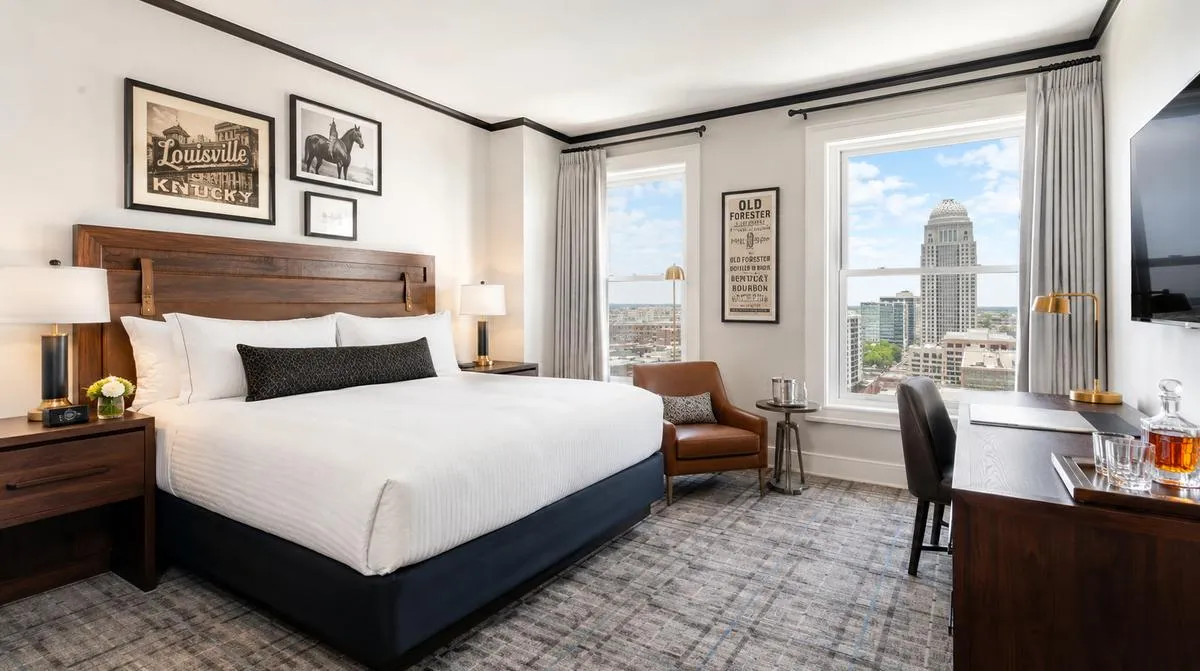
The most successful Louisville boutique properties thread this needle through material selection rather than iconography. Cognac leather on a lounge chair or ottoman doesn't say "Kentucky Derby" explicitly, but it carries the warmth and craft-quality association that Derby culture embodies. Dark walnut casegoods in a guest room feel rooted and substantial without requiring horseshoe hardware to signal location.
For NuLu properties with a more contemporary brief, the approach shifts toward contrasts: a light-toned linen headboard against a dark accent wall, or a mix of natural oak and black-powder-coated metal in lounge seating. Ottomans in performance velvet serve double duty as coffee tables and extra seating in smaller rooms a practical choice that boutique guests actually use and appreciate.
Personalization is a real differentiator at boutique scale. Unlike a 300-room branded hotel that needs absolute consistency, a 40-room boutique can mix two or three chair styles across different floors, creating a sense of curation that guests read as intentional.
Procurement for Boutique Properties
Boutique hotel buyers typically manage FF&E without a dedicated procurement department, which means a supplier's ability to handle the relationship end-to-end from specification to delivery coordination matters enormously. Look for suppliers who offer sample programs, provide CAD or specification documentation for permit and design review, and have experience coordinating deliveries into NuLu's narrower streetscape.
Lead times for boutique projects follow the same rules as the broader Louisville market: complete installation before mid-April if a spring opening is planned. Custom pieces run 10-14 weeks; stocked programs 2-4 weeks. With smaller room counts, boutique operators have more flexibility to stage deliveries but that also means less tolerance for missing pieces on opening day.
Ready to spec boutique hotel furniture for your Louisville project? Send us the details and we will price it around your requirements. Request a quote to start.
Related reading
- Banquet tables in Louisville: sizing and specs
- What is contract furniture
- Hotel furniture supplier guide
- Hospitality furniture supplier guide
- Lounge chairs for boutique hotel guest rooms
- Hotel headboards and upholstered bedroom furniture
- Ottomans for boutique hotel rooms
- Commercial furniture in Kentucky
Our take
Derby Week compression, which this post rightly treats as the durability benchmark, also hands Louisville operators something most markets never get: a precisely dated stress test. The hardest week of the furniture year lands on the same calendar square every spring, which means recovery can be scheduled before the damage happens rather than reacted to afterward.
The bottom line: Good district level guidance for NuLu and Whiskey Row. The operational move that compounds it is a fixed post Derby maintenance audit every May, timed to the one week Louisville knows in advance will be its hardest.