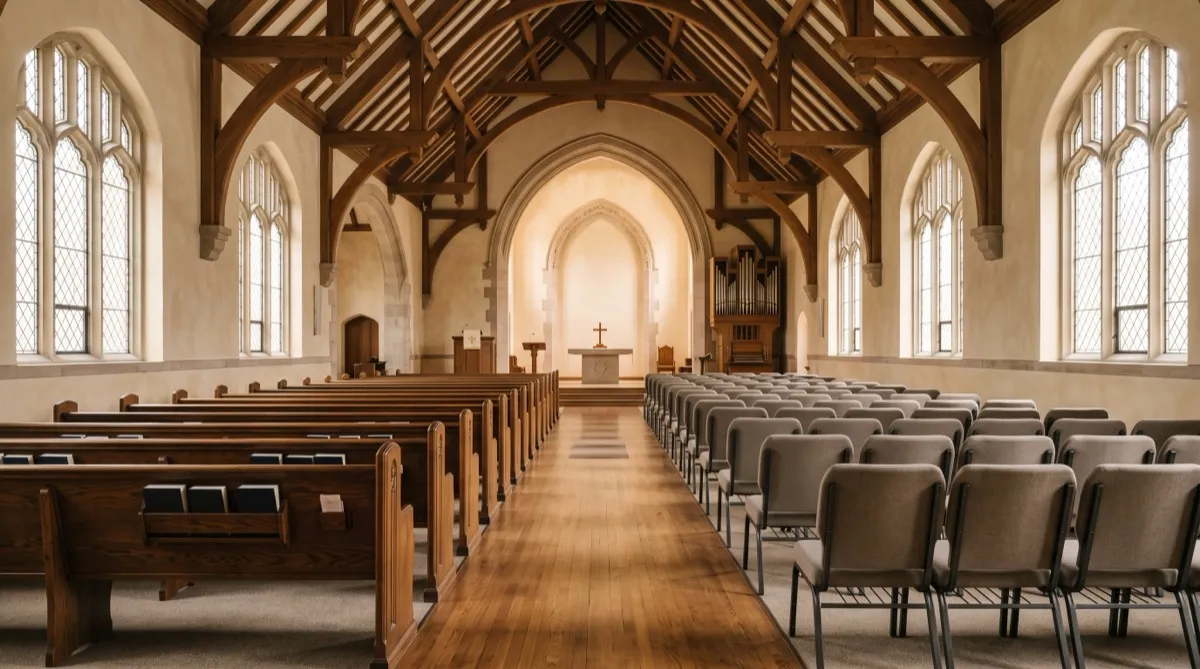
Few renovation decisions carry as much emotional weight for a congregation as whether to keep pews or move to chairs. It's practical on the surface, seating capacity, comfort, cost logic, but it's also a question about tradition and identity that a pure furniture comparison doesn't fully capture. Here's how to work through both sides of it.
What pews actually offer
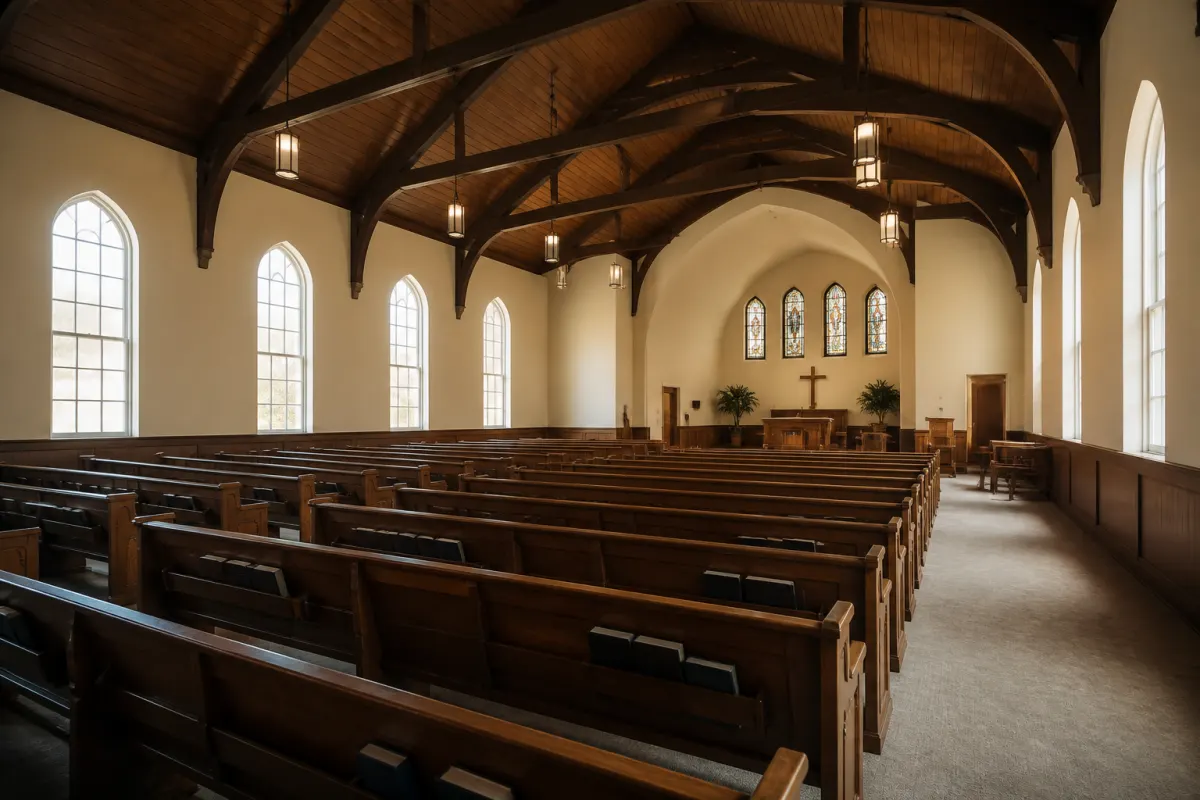
Pews are fixed, permanent, and built to last. A well-built wood pew, properly maintained, can serve a sanctuary for generations, and many congregations have pews that predate most of the current membership. That permanence is exactly the point for congregations where continuity and tradition are central to the worship identity, the pews aren't just seating, they're part of the building's history and often carry memorial dedications tied to specific families.
Pews also seat efficiently in a traditional layout. A full pew accommodates variable numbers of people shoulder to shoulder without fixed seat divisions, which can flex capacity slightly higher than the same run of individual chairs, especially for a large holiday service where a congregation packs in more tightly than a typical Sunday.
The tradeoffs are real, though. Pews are fixed in place, which means the sanctuary can't reconfigure for anything other than a traditional forward-facing worship service. They're heavier and harder to move for cleaning, and comfort is largely fixed by a design that in many older sanctuaries predates modern ergonomic expectations.
What chairs actually offer
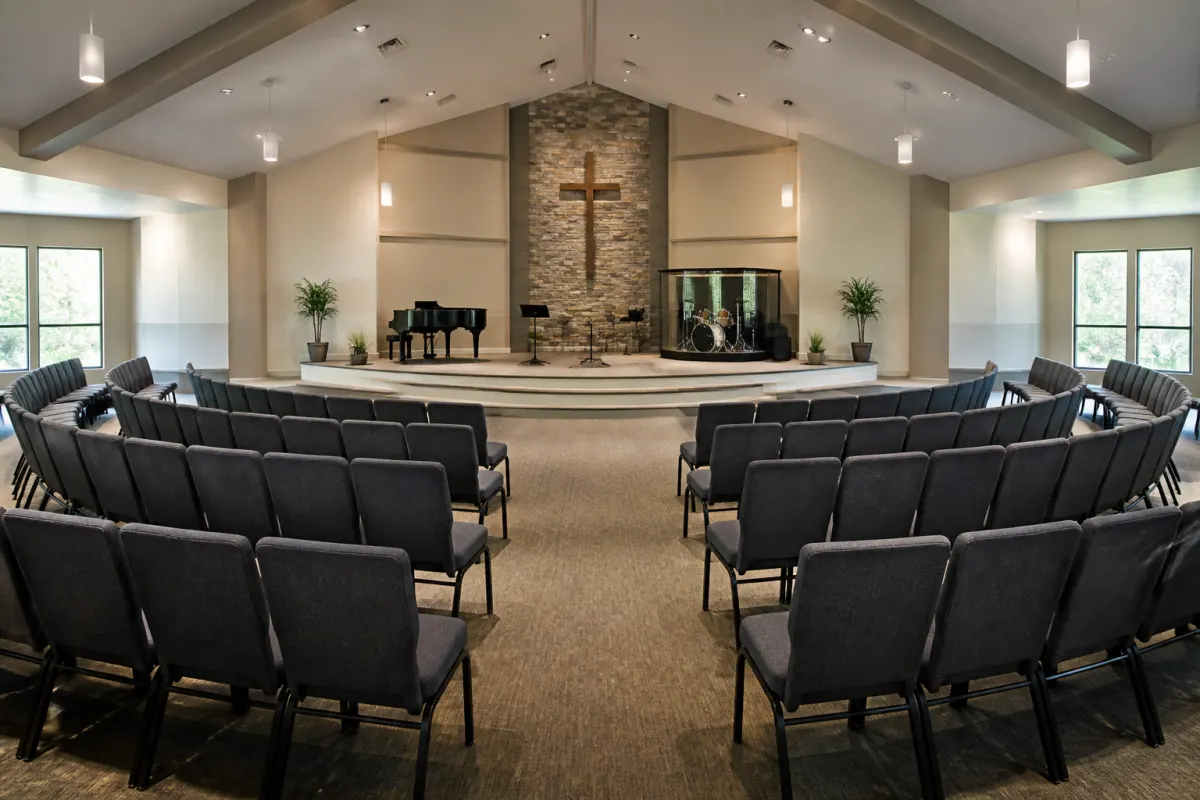
Chairs bring flexibility a fixed pew simply cannot. A chair-based sanctuary can reconfigure for different worship styles, in-the-round, theater-style, small-group formats, in a way a room full of fixed pews never can. Stacking or interlocking chairs let a multipurpose space serve as sanctuary on Sunday and community hall, event space, or overflow classroom the rest of the week, which matters enormously for a growing congregation with limited square footage.
Chairs also allow phased replacement. A congregation can update seating in sections over time as budget allows, where a pew renovation typically has to happen as a larger single project given the fixed, connected nature of a pew installation.
Comfort is often the deciding factor for congregations making the switch. Modern padded church chairs, built to a commercial seating standard, offer support and cushioning many older wood pews don't, particularly for a longer service length or an aging congregation for whom comfort genuinely affects attendance and participation.
The capacity math, without dollar figures
Run the actual numbers before deciding based on impression alone. Measure your existing pew seating capacity at both a typical Sunday density and a full holiday density, since congregations often assume pews seat more than chairs would in the same footprint, and that assumption isn't always true once you measure it.
Individual chairs with proper aisle spacing and code-compliant row spacing can come close to matching pew capacity in most sanctuary layouts, particularly when chairs are ganged together in rows rather than spaced as fully independent seats. The gap, where it exists, is usually smaller than committees expect going in, and it's worth measuring your specific space rather than assuming pews automatically win on raw capacity.
Congregation expectations and the emotional layer
This decision rarely fails on the furniture merits alone. It fails when the congregation feels the decision was made without them, particularly around memorial pews or long-standing tradition. Bring the congregation into the conversation early, not as a rubber-stamp vote at the end of a committee process already locked into an outcome.
Consider whether memorial elements can carry forward into a new seating plan, a dedication plaque relocated to a new area, a small preserved pew section retained as a historical or memorial space even if the majority of the sanctuary converts to chairs. These compromises often resolve more resistance than a purely functional argument about flexibility or comfort ever will.
The hybrid approach
Many congregations don't choose one or the other completely. A common hybrid keeps pews in the main sanctuary body while adding chairs in overflow areas, side chapels, or a flexible rear zone that can be cleared for standing-room capacity or a different configuration. Others convert fully to chairs but design the layout to visually echo the traditional pew arrangement, straight rows, center aisle, so the change in materials doesn't feel like a change in worship character.
A hybrid approach also lets a congregation test chairs in a lower-stakes area before committing to a full sanctuary conversion, which can build confidence in the decision before the larger, more visible project.
What CFD provides in this decision
CFD supplies church chairs and full seating programs, padded, stacking, and sanctuary-specific options built to the same commercial durability standard used across our other seating lines. We do not manufacture or supply pews; where a congregation is weighing pews as part of this decision, that side of the comparison should come from a pew specialist, while we help spec, quote, and deliver the chair side of the project, whether that's a full conversion or a hybrid layout.
Sourcing and lead times
Church chairs are typically built to order, with lead times of 10 to 14 weeks for custom fabric and finish selections. In-stock options move faster for congregations on a tighter renovation timeline. This decision connects directly to the broader church furniture program most committees are planning at the same time, seating, lobby, and multipurpose room furniture together.
Request a quote with your seat count and target layout and we'll help you run the real capacity numbers before the committee finalizes a direction.