Most office chair shopping defaults to arms, and for a private office or a standard desk that default is usually right. But there is a specific set of commercial layouts where armless task seating is the better spec, not a cost-cutting compromise, and buyers who skip past that category miss a real functional gain.
Here is when armless task chairs earn their spot, and what to look for once you decide they're the right call.
The case for going without arms
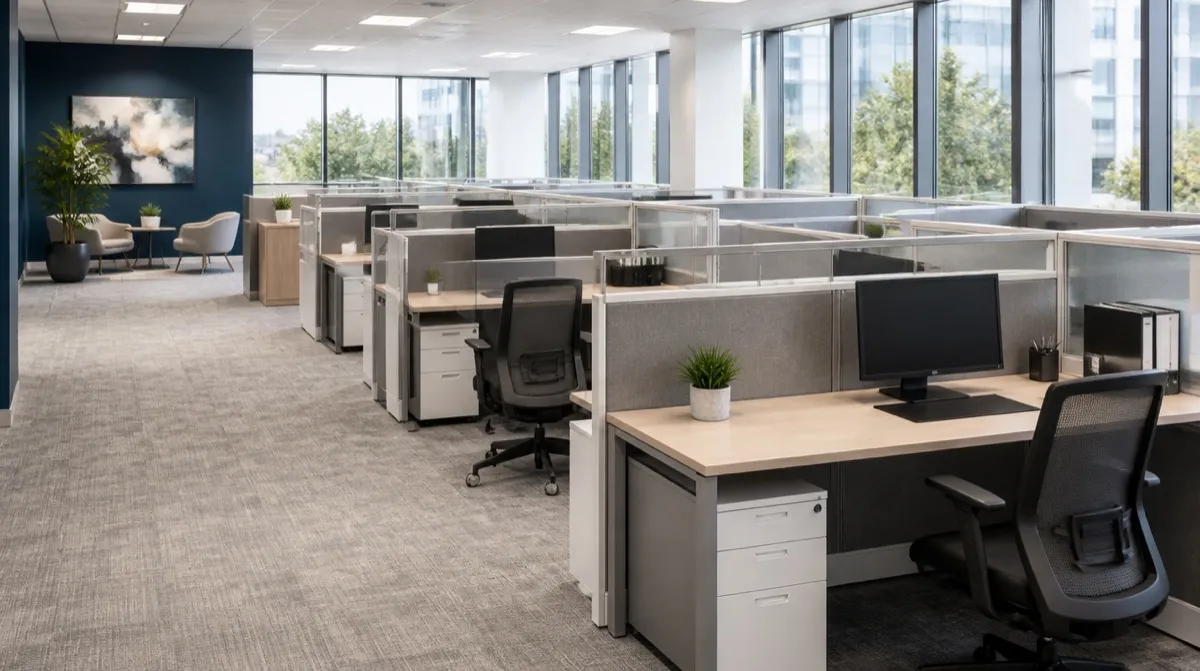
Bench desking and tight desk runs. Shared bench-style desking has become the default layout for a lot of open-plan offices, and armless chairs are what make tight desk spacing actually work. Arms add width to a chair's overall footprint even when the chair itself is compact, and on a bench desk with runs spaced 48 to 60 inches apart, that extra width is the difference between chairs that tuck cleanly under the desk and chairs that collide with their neighbors every time someone sits down or stands up.
Tuck-away density. An armless chair pushes fully under a desk, leaving a clear walkway when the seat isn't in use. Chairs with arms almost always leave the arm caps proud of the desk edge, narrowing walkways in already tight floor plans. In any space where aisle width is at a premium, whether that's a call center floor or a training room set up for a full class, tuck-away density adds up fast across dozens of workstations.
Callcenter and training-room floors. These environments prioritize a different set of things than a private office does: maximum seat count per square foot, chairs that reset cleanly between shifts or sessions, and low per-unit cost across a large order. Arms add cost, width, and one more component that can break, without adding much functional value in a role where the user is typically on a headset or keyboard rather than resting elbows.
What you give up
Arms support the shoulders and reduce strain during long stretches of typing, and for any role that spends eight hours a day at a keyboard, that support is a real ergonomic benefit worth keeping. Arms also help people get in and out of a chair, which matters more than most buyers expect, especially for a workforce with a wide range of ages and physical needs.
The honest read: armless chairs are a legitimate spec for specific layouts and roles, not a universal upgrade. If your floor plan has the room and your roles involve sustained desk work, chairs with height-adjustable arms are usually the better default. Reserve armless seating for the layouts where density and mobility genuinely outweigh the arm-support tradeoff.
What to spec on an armless task chair
Losing the arms does not mean lowering the rest of the spec. A commercial armless task chair should still carry a five-star base on commercial-rated casters, a tilt mechanism built for continuous use, and adjustable seat height with a real gas-lift cycle rating, not a light-duty lift meant for occasional home use.
Lumbar support matters more on an armless chair, not less, since the user loses one point of postural support and the seat back has to carry more of that job. Look for contoured lumbar shaping built into the back rather than a bolt-on pad, which tends to shift out of position under daily use and stops doing its job within a few months.
Upholstery should carry the same 50,000-plus Wyzenbeek rating you'd want on any commercial task chair. Mesh backs work particularly well on armless chairs in high-density floors, since they breathe better across a long shift and shed less visible wear than fabric under constant contact.
Sizing the order
Armless chairs are typically ordered in volume, since the layouts that call for them (bench desking, call centers, training rooms) tend to be large-headcount environments to begin with. That volume works in your favor on pricing, but it also means a single wrong sizing decision multiplies across the whole order. Confirm seat depth and height range against your actual workforce before committing to a large order, and request a sample chair for in-person sit-testing whenever the order crosses fifty units.
Stackability is worth checking at the same time. Training rooms and multipurpose floors that reconfigure often benefit from an armless chair rated for stacking, since removing the arms also removes the biggest obstacle to a clean stack. A stackable armless chair frees up storage space between sessions and cuts setup and breakdown time for facilities staff who move furniture on a regular schedule, which is a real operational win that a fixed-layout private office would never notice or need.
Finish and color choices deserve a second look on large armless orders too. Bench desking and open floors are often visible from multiple angles at once, so a mismatched or overly varied color run across dozens of chairs reads as disorganized in a way it would not in a private office with one or two chairs per room. Standardize on one or two approved finishes for the whole floor before you place the order, and confirm the supplier can hold that finish consistently across a reorder months later if your headcount grows.
Run your full seat count through our furniture cost calculator to model freight and volume breaks before you request a formal quote. For the full range of task seating options, our contract office furniture guide covers arms, mesh versus upholstered backs, and base ratings across the category. Browse desk chairs directly, or request a quote to price out a full floor.