Most lobby furniture is bought for the layout it will sit in on day one and stays exactly there until it's replaced years later. Modular ottoman systems are the exception. A curved, wedge, or straight ottoman section can be ganged into a tight circular cluster for a slow Tuesday afternoon and reconfigured into a long bench line for a Friday evening event, all with the same set of pieces. That flexibility is the entire value proposition, and it's also where a lot of buyers underspec the system by treating it like a fixed furniture purchase instead of a kit of parts.
How modular ottoman systems are built
A modular system is made up of individual sections, typically a mix of straight, curved, and corner or wedge pieces, that connect using a hidden hardware system rather than sitting loose next to each other. The connection hardware matters more than it looks like it should. A basic system that relies on friction or simple bracket clips will drift apart under regular use as guests sit down, get up, and lean against the pieces throughout the day. A well-engineered system uses a locking or bolt-through connector that keeps sections aligned and flush, so the cluster reads as one continuous piece even after months of daily rearranging by staff.
Ask specifically how sections connect and how long reconfiguring a cluster takes in practice. A system that requires tools or takes staff twenty minutes to reassemble defeats the purpose of buying modular pieces in the first place. The better systems are designed for a facilities or event staff member to reconfigure a cluster in a few minutes without any special training.
Curved sections and the shapes they enable
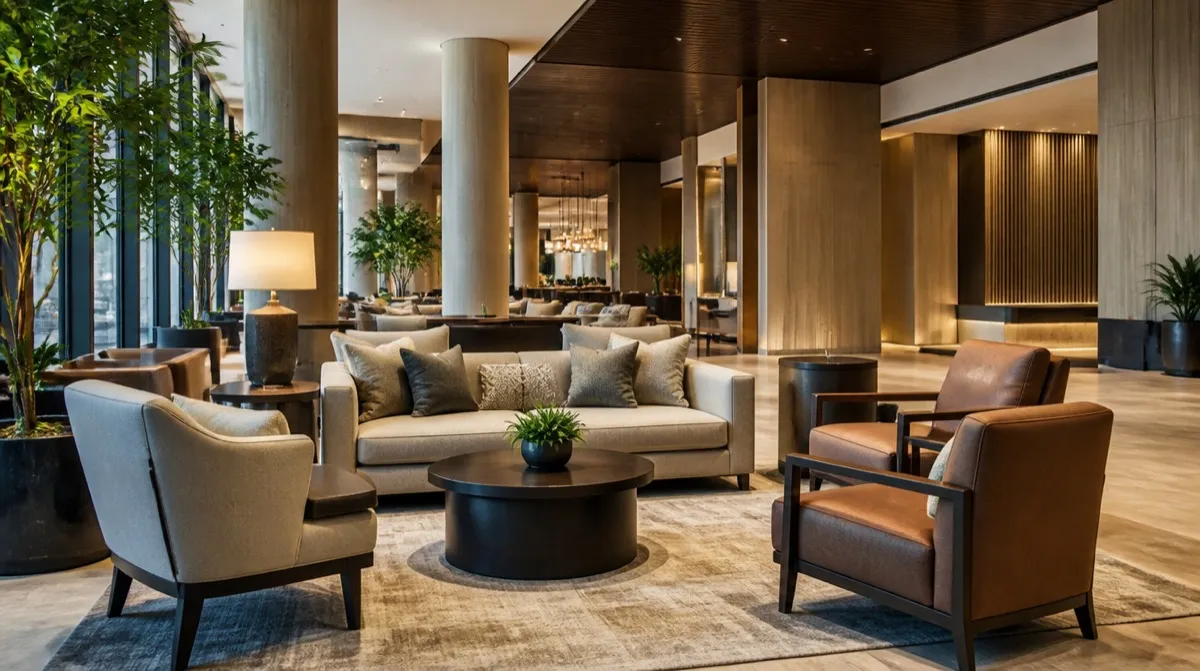
Curved ottoman sections are what make circular or organic clusters possible, and they're the piece most buyers underorder relative to straight sections. A cluster built entirely from straight sections can only form polygons with visible angles at each joint, while adding curved sections lets a layout follow an actual circular or oval footprint, which reads as more intentional and works better around a central cocktail table or floor feature. If your lobby has curves in the architecture itself, like a rounded reception desk or a circular rug, matching curved ottoman sections to that geometry ties the whole space together in a way straight sections alone can't.
Fabric and frame specs stay the same as standard ottomans
A modular ottoman still needs the same underlying commercial spec as any standalone ottoman: a kiln-dried hardwood or engineered plywood frame, 35 to 40 ILD foam, and performance fabric or vinyl at 50,000 Wyzenbeek double rubs or higher. The modular hardware is an addition to that spec, not a substitute for it. Our commercial ottomans guide covers the frame and fabric fundamentals in more depth, and everything in that guide applies directly to modular sections. Check any fabric candidates against our event space calculator alongside your section count to model both the seating capacity and the delivered cost of a full modular order.
Planning quantity around real reconfiguration needs
Order quantity for a modular system should be based on the largest configuration you'll actually need, not the everyday baseline layout. A property that regularly hosts events needs enough sections to expand into a larger footprint on demand, with the smaller everyday cluster being a subset of that larger inventory rather than the full order. Underordering sections is the most common mistake with modular systems, since it forces staff to choose between a cramped event layout or leaving gaps in the design during regular operation.
Storage for unused sections
Facilities that reconfigure often need somewhere to stage sections not currently in use, and that storage space should factor into the purchase decision, not get solved after the furniture arrives. Sections with protective glides or covers for storage periods, and a storage area sized to the bulkiest curved pieces, keep the system in good condition between reconfigurations. Our commercial lounge seating guide covers how modular ottomans fit into a broader flexible lounge plan alongside sofas and armchairs that may also need repositioning for events, and the ottomans category shows current modular section options.
Ordering and lead time
Modular systems typically run on the same ten to fourteen week production window as other custom upholstered lounge furniture, and matched fabric across every section in a large system is worth confirming explicitly, since dye lots can shift between production batches on a large order placed over time.
Staff training and reconfiguration ownership
A modular ottoman system only delivers its full value if staff actually reconfigure it when the space calls for it, and that requires a little more than handing over a delivery. Walk your facilities or event team through the connector system when the furniture arrives, and put someone specific in charge of maintaining the everyday layout so pieces don't drift into a permanent arrangement out of convenience. Properties that skip this step often end up with an expensive modular system that functions as fixed furniture within a few months, which defeats the entire reason to spec modular over standalone ottomans in the first place.
Label or color-code sections during installation if your system includes several different shapes, so staff resetting a layout after an event aren't guessing which curved piece goes where. This sounds minor, but it's the difference between a five-minute reset and a frustrated staff member improvising a layout that doesn't match the original design intent. When you're ready to plan a modular lobby seating system, request a quote with your maximum event configuration and typical everyday layout, and a commercial specialist can help size the section count correctly for both.