
Ganging hardware connects adjacent movable chairs into a planned row. Compare its behavior with loose chairs during an actual setup trial rather than assuming every sanctuary row stays perfectly straight or that a connector prevents every kind of movement.
What interlocking actually means
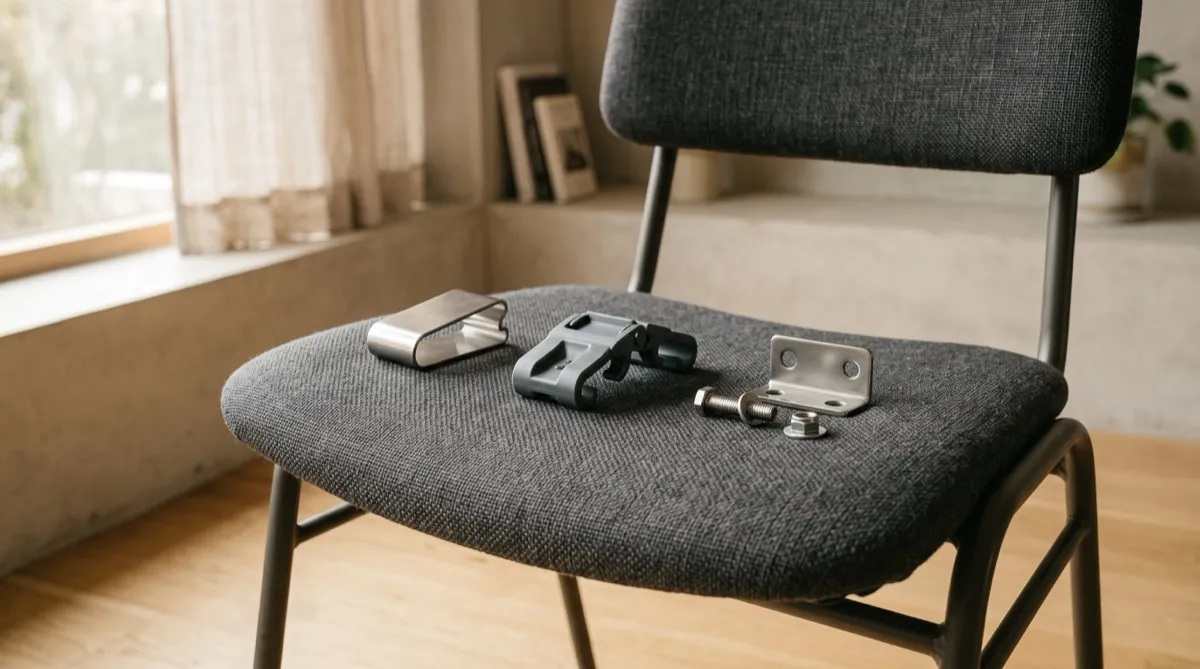
A ganging system may use a clip, hook, bracket, or bar to connect adjacent chairs. Obtain the selected assembly's engagement instructions, compatible models, permitted geometry, and test documentation. A connected row is not automatically one rigid structural unit or immune to movement.
For an illustrative 300-chair room, mark row positions and aisle boundaries and observe them after a representative use and reset trial. Compare loose and connected configurations with the same chairs; do not assume a particular drift rate or alignment result from the chair count alone.
Check the applicable connected-seating requirement
Ask the project team and authority having jurisdiction whether the adopted assembly provisions require connected or secured seating for the proposed occupancy, row count, and layout. The exact requirement and permitted arrangement need those project facts; the article does not establish a universal chair-count trigger or evacuation performance for a ganged row.
If considering ganging beyond a required arrangement, define the intended alignment and reset benefits and test the proposed assembly. Future code acceptance and day-to-day stability cannot be inferred from the presence of a connector alone.
Connector types
Hook-and-loop metal connectors: if proposed, check how the hook engages the matching loop or slot, whether tools are required, and the maker's allowed connection and release sequence. Time the actual assembly; the style name does not establish speed or prevalence.
Clip-style plastic or metal clips: ask which frame and chair versions they fit, how full engagement is checked, and whether repeated reset use is documented. Confirm weight, cost, and release time for the selected system.
Under-seat bar connectors: compare their attachment points, spacing, tools, and release procedure with the planned row and reset frequency. A bar connection is not automatically limited to heavier or permanent installations.
Straight rows versus curved rows
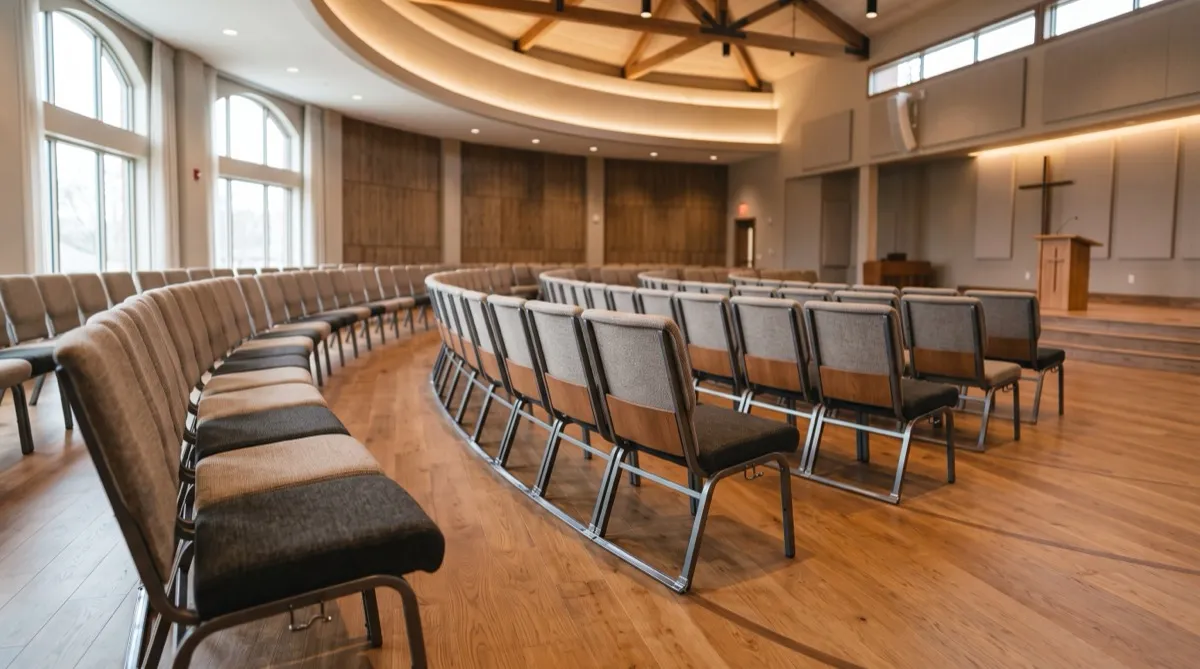
Draw both straight and curved rows with the exact chair and connector dimensions. Ask the maker which row angles and gaps the assembly permits and whether different hardware is required. Do not bend, space, or combine connectors beyond the approved arrangement to create a curve.
Setup and teardown with ganged chairs
For a room that changes use, time connection and release with the selected hardware and trained setup team. Three seconds per connection in a 300-chair room is an illustrative labor input, not an observed result; count actual connection points and include inspection, chair handling, and storage trips.
For weekly resets, ask the maker for intended-use and engagement-cycle documentation and the inspection or replacement criteria. Frequency alone does not prove that an occasional-use assembly will loosen or that another system is suitable.
Retrofitting ganging hardware to existing chairs
For a retrofit, identify the existing chair model and ask its maker whether an approved connector kit exists, which attachment points it uses, and what installation and inspection are required. Do not assume reinforcement or hardware availability because the frame resembles a ganging version; do not drill or attach an aftermarket connector without approval.
Compare an approved retrofit proposal with replacement on the same row-layout, handling, and inspection requirements. Include installation labor and any retired chairs. Confirm that the proposed assembly meets the project's adopted requirements rather than treating lower upfront cost as proof that a retrofit solves the need.
Inspection and maintenance
Ganging hardware is a wear point like any mechanical connection, and it benefits from periodic inspection, particularly in installations that reconfigure rows often. Check that hooks and clips engage fully rather than partially, since a partially engaged connector can give the visual appearance of a secured row while providing little of the actual holding strength. Look for elongation or wear at the connection point on chairs that have been in service for several years, since repeated engagement and disengagement does gradually wear metal-on-metal connectors. Set inspection intervals from the hardware maker's instructions and your actual reset frequency. A quarterly review can be a scheduling example, but it does not establish that sampling a few rows will catch most faults. Check engaged connections during setup, isolate damaged hardware, and record recurring wear before returning affected chairs to service.
Sourcing interlocking chairs
Use the church furniture planning hub to assemble a brief for straight or curved rows and the expected reset frequency. Ask suppliers which exact chair and connector assemblies support that arrangement; a generic ganging label does not confirm curved-row compatibility. Establish the applicable local connected-seating requirement with the project team before ordering. Run the room through the church seating capacity calculator for an area-based chair-count scenario, then check the drawn rows and count the actual connection points and planned breaks.
Related reading
Need chairs rated for your row layout and reconfiguration frequency? Request a quote with your row count and whether your sanctuary uses straight or curved rows.
Our take
Plan accessible positions on the same drawing as the ganged rows. The US Access Board assembly provisions address integrated wheelchair spaces, companion seats, and dispersion where those standards apply. Federal Title III applicability is not automatic for a church: the Department of Justice lists religious organizations among its exemptions, while adopted state or local requirements can still apply. Have the project team establish the applicable rules, then map wheelchair positions, companion seats, clear approaches, and the connections omitted at each planned break. A chair removed mid-service is not a substitute for a correctly sized accessible position.
The bottom line: Draw accessible positions, companion seats, and clear approaches before ordering connectors. Confirm the applicable assembly and accessibility requirements with the project team, and count hardware against that approved row plan.