Colorado Springs runs on a mix of demand that most hospitality markets do not have to plan around at the same time. You have properties near Fort Carson and Peterson Space Force Base filling rooms with permanent-change-of-station travel and government per diem stays that do not follow a normal seasonal curve. You have the US Air Force Academy pulling in visiting families and official travel throughout the year. You have a summer tourism surge built around Garden of the Gods and Pikes Peak that pushes occupancy hard from June through September, and a downtown corridor along Tejon Street where boutique and select-service properties compete for the same leisure guest. If you are sourcing furniture for a hotel project anywhere in the Colorado Springs metro, here is what that market actually requires from your supply chain.
What Makes Colorado Springs Different for Hotel Furniture Sourcing
Colorado Springs is not a single hospitality market, it is several running on top of each other. A select-service property near the interstate corridor by Peterson Space Force Base sees government and military travel that is steady but budget-conscious, favoring durable, no-frills furnishings over statement pieces. A downtown boutique property near Tejon Street is competing on character and design for the leisure traveler who chose Colorado Springs over Denver for the mountain access. A property closer to Garden of the Gods or Manitou Springs is dealing with a tourism-driven guest who is out the door early and back late, putting heavy but irregular wear on lobby and common-area furniture. Your furniture supplier needs to understand those distinctions, not just quote you from a catalog.

The Pikes Peak region's tourism season concentrates demand into a tight window. Furniture in lobbies and breakfast areas at properties near Garden of the Gods and the US Olympic and Paralympic Training Center absorbs a summer's worth of heavy traffic in roughly four months, then sees a much quieter shoulder season. That cycle is different from a market with steady year-round occupancy, and it changes how you should think about durability ratings. Ask your supplier for the actual specification data: foam ILD ratings, fabric Martindale rub counts, frame material and joinery documentation. If they cannot provide that, keep looking.
Properties tied to the military and government travel segment near Fort Carson and the Air Force Academy sit at a different end of the spec conversation. Occupancy there is more consistent across the calendar, but budget discipline matters more, and furniture programs need to hold their appearance through years of steady, unglamorous use rather than a single intense season. A hotel furniture supplier in Colorado Springs who only understands one side of this market is going to leave gaps, on a downtown boutique project just as much as on a select-service property built around government per diem stays.
Why Contract Grade Matters in This Market
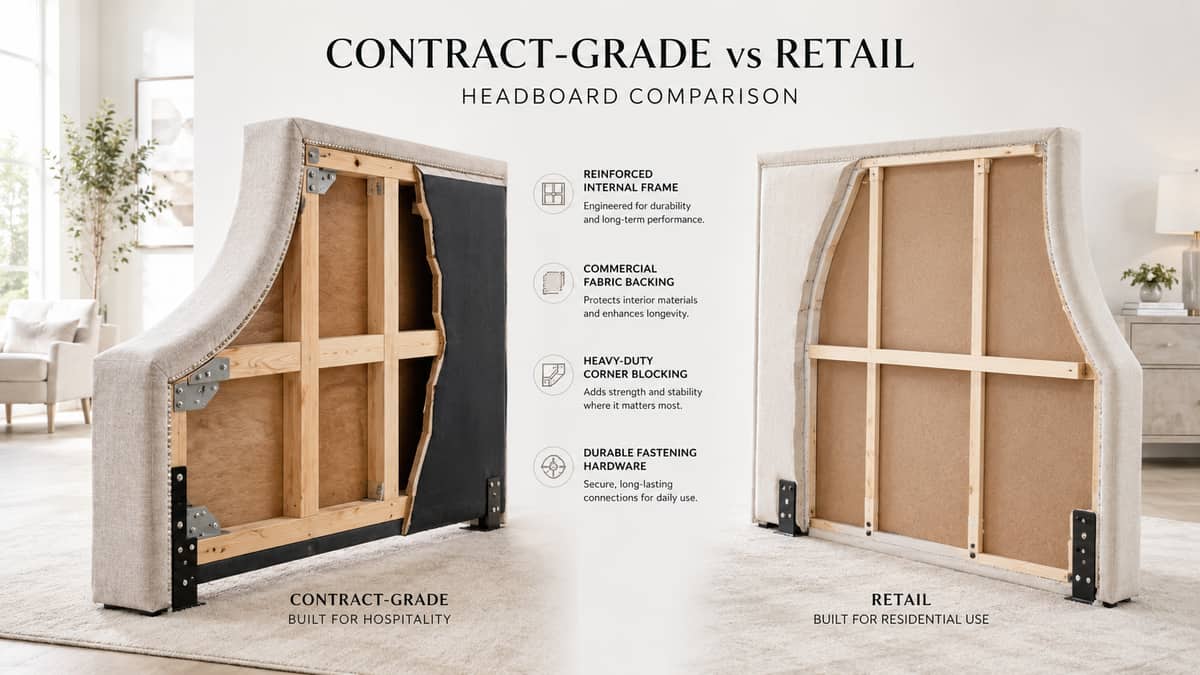
This is the conversation that saves you money over time even when it costs more upfront. Retail furniture is engineered for residential use, light daily use, careful handling, the assumption of periodic replacement as a style decision. Hotel furniture lives in a fundamentally different environment.
A lobby chair at a Colorado Springs property near Garden of the Gods might see hundreds of sits in a single peak-season week. A guest room bed frame gets shifted by housekeeping staff multiple times daily, year-round. Drawer hardware in a downtown property near Tejon Street gets opened and closed under far more use cycles in a month than residential hardware sees in a year. When retail furniture fails in those environments, and it does fail faster than you expect, the consequences are not just a replacement order. They are liability exposure, maintenance budget overruns, and the kind of guest experience failure that ends up in a review before the guest has left the building.
Contract-grade furniture from a qualified hotel furniture supplier meets BIFMA standards or equivalent hospitality certification benchmarks that retail products are never subjected to. The frame construction is reinforced for commercial load cycles. The finishes are tested for durability under institutional cleaning protocols, which matters in a high-altitude, dry climate where furniture ages differently than it does at sea level. The price difference between contract and retail product pays for itself before the end of the first replacement cycle in almost every hospitality application. Ask your supplier for documentation. If they hesitate, that tells you everything you need to know.
Lead Times, Logistics, and Getting the Timeline Right
Colorado Springs hotel projects run on calendar pressure that varies by segment. A new boutique property downtown might be racing to open before the Pikes Peak summer tourism window. A renovation near Fort Carson needs to wrap without disrupting a guest base that books government travel on a rolling basis. A property near the Air Force Academy is coordinating around graduation weekends and official visits that cannot slip.
In every one of those scenarios, lead time is the variable that determines whether you hit your target date. Standard lead times from contract furniture suppliers run 10 to 16 weeks for domestic production. Import orders stretch to 20 weeks or longer once you factor in shipping, customs, and any port delays. That math is not flexible when you have a pre-opening booking horizon or a financing draw tied to substantial completion.
Lock your furniture specs at the same time you finalize interior design drawings. A supplier worth working with in Colorado Springs will turn around physical samples fast enough to keep your design and ownership review process moving, offer phased delivery sequencing for larger projects, and raise lead time risks early enough that you can act on them. Minimum order quantities matter here too, particularly for boutique and independent properties furnishing 40 to 90 rooms rather than 200. Most contract suppliers set MOQs at the piece level by category, 20 to 50 units per SKU is common for upholstered pieces, with more flexibility on casegoods.
How to Evaluate a Hotel Furniture Supplier in Colorado Springs
Start with their actual project history in mountain-west hospitality markets. A supplier with completed installations across Colorado Springs property categories, government-adjacent, boutique, tourism-driven, understands the aesthetic range and the operational demands this market places on furniture. Ask for references from projects comparable to yours in scale and budget, then call those references.
Logistics capability is as important as product quality. Colorado Springs deliveries still involve building management coordination, elevator scheduling in occupied properties, and working within general contractor timelines, and the region's altitude and weather swings add their own scheduling risk. A supplier with in-house white-glove delivery and installation experience in commercial environments handles those constraints before the truck leaves the warehouse.
The right hotel furniture supplier in Colorado Springs is not a vendor you transact with once and move on from. In a market this varied, where military and government travel, a downtown boutique scene, and a heavy seasonal tourism draw are all operating at the same time, they are a project partner. Every product page links straight to a quote request, so you can get pricing moving as soon as your spec is locked.