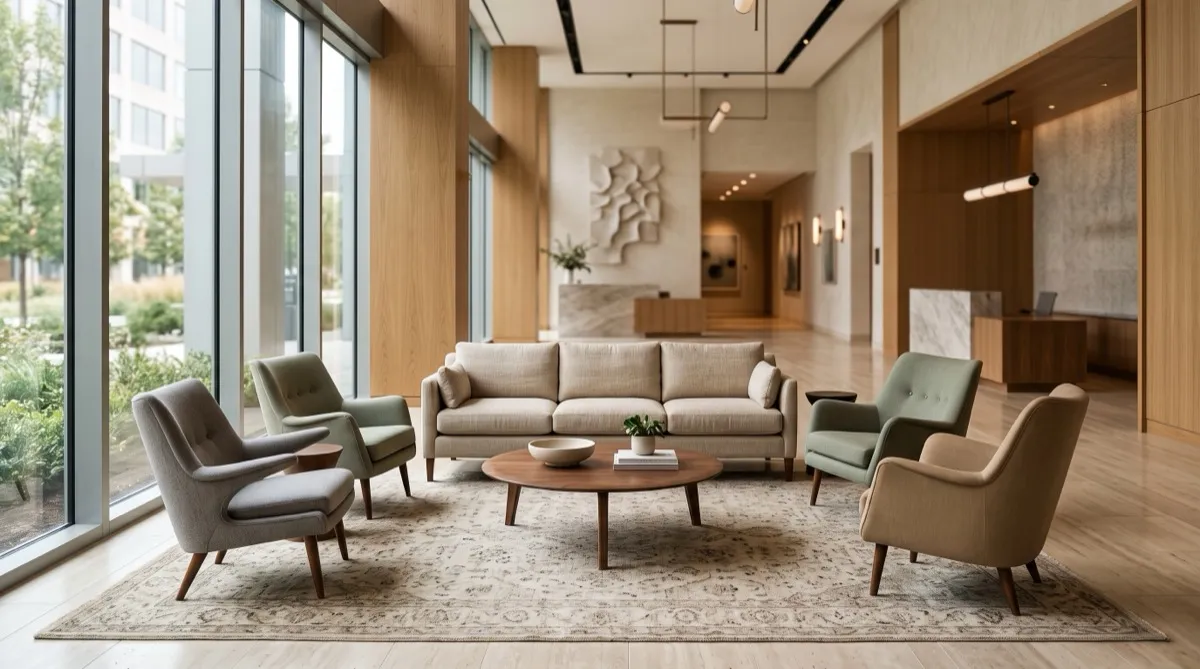
Hospitality is the most demanding room in the contract furniture world, and hospitality contract furniture manufacturers build to that reality. A hotel never closes. A guest room turns over hundreds of times a year, a lobby sees traffic from dawn to well past midnight, and a food and beverage outlet runs cleaning chemicals across every surface daily. Furniture specified for a home, or even for a lighter commercial setting, does not survive that clock. This guide covers how hospitality furniture is engineered differently and how hotels and restaurant groups actually buy it.
If you are new to the category as a whole, start with the contract furniture buyer's guide for the fundamentals, then come back here for the hospitality-specific layer.
Why 24/7 occupancy changes the spec
The defining fact of hospitality is that the furniture is never resting. That single condition drives most of the specification decisions.
Frames take constant load and constant movement. Guests sit heavily, drag chairs rather than lift them, and lean on case pieces. Hospitality seating uses heavier gauge steel or kiln-dried hardwood, corner blocks, and welded or double-doweled joints because the joint is the first thing to fail under that duty cycle. Casegoods, the dressers, nightstands, headboards, and desks in a guest room, take moisture, luggage impacts, and industrial cleaning, so edges are banded and surfaces are rated for heavy wipe-downs.
Upholstery is where hospitality separates hardest from residential. Fabrics and vinyls are rated in double rubs for abrasion and are chosen to survive commercial cleaning cycles, not gentle household care. In many occupancies they also need to meet flame and fire ratings, which vary by jurisdiction and building type, so treat any general standard as a starting point and check local code. You can sanity-check a specific textile against your traffic level with the fabric durability checker before it goes into a spec.
Brand standards: the rulebook behind the order
The thing that surprises first-time hospitality buyers is that much of the decision may already be made. Branded hotels operate under brand standards, detailed specification documents from the flag that dictate what furniture is allowed in each space, down to dimensions, finishes, durability ratings, and sometimes approved suppliers. An owner furnishing a branded property is not choosing freely, they are executing a standard and proving compliance.
Independent and boutique properties have more freedom, but they trade the rulebook for the burden of writing their own spec. That is why boutique projects lean so heavily on designers to define durability and finish, and why a boutique hotel furniture program still has to hit contract-grade construction even when the look is bespoke. Either way, the spec is the contract. Everything downstream keys off it.
The FF&E package, zone by zone
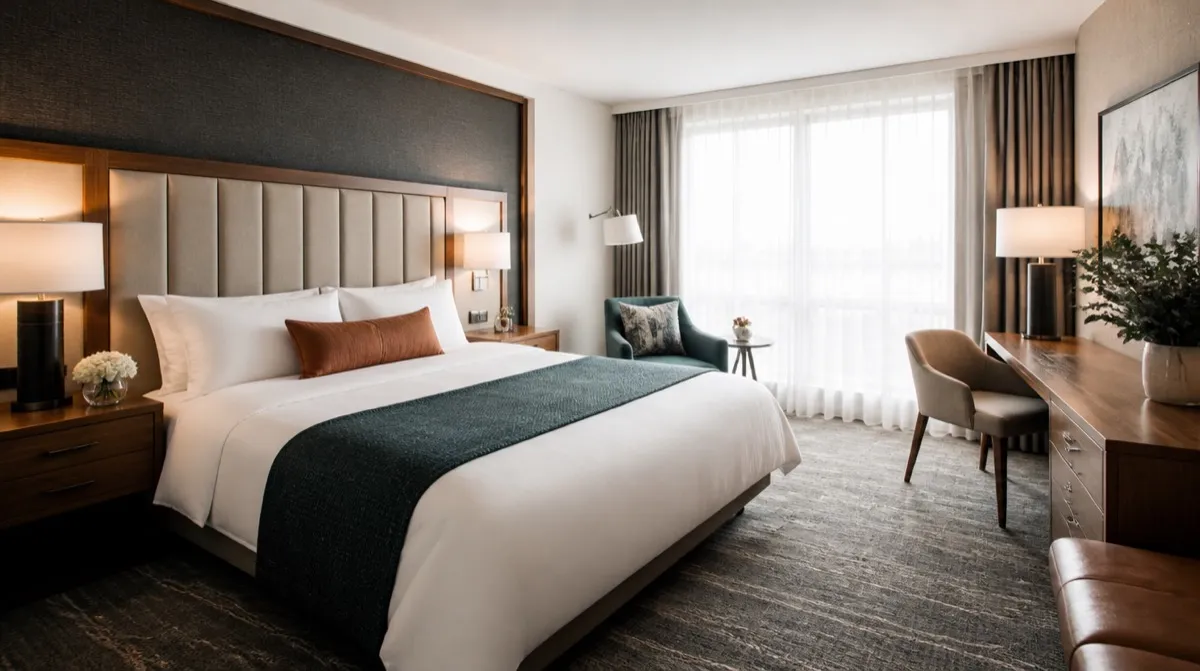
Hotels do not buy furniture, they buy an FF&E package, the coordinated set of furniture, fixtures, and equipment that turns a construction shell into a working property. Hospitality contract furniture is the furniture slice of that package, and it is planned by zone.
Guest rooms carry the largest count: headboards, casegoods, a desk and desk chair, and a lounge chair or two. Because the same room repeats dozens or hundreds of times, a small per-room saving or a small per-room defect multiplies fast, so guest-room specs get the most scrutiny. The hotel casegoods guide and hotel guest room furniture guide go deeper on that zone.
Public spaces, the lobby, lounge, and corridors, run on sofas, lounge seating, and occasional tables that read premium while taking heavy traffic. Food and beverage outlets, the restaurant, lobby bar, and pool bar, carry side chairs, barstools, booths, and tables specified closer to restaurant contract grade because they turn covers constantly. Meeting and event space runs on stackable banquet chairs and tables that store between functions.
The mistake to avoid is treating the food and beverage furniture as an afterthought once guest-room and lobby budgets are set. Across a full-service property with two or three outlets, the F&B furniture is a meaningful share of the total once seating, bar, and tables are priced at volume, and it takes the hardest daily use. Budget it as its own line from the start.
How hotels and restaurant groups actually buy
Two buying patterns dominate hospitality, and they shape how you should approach a supplier.
Single-property owners, whether renovating or opening, run a defined project with a hard opening date. The whole game is protecting that date. The FF&E workflow moves through specification, bidding and value engineering, purchase orders, production, freight and warehousing, and delivery and install. Because custom finishes and large factory-direct quantities carry real production lead times, ordering late is the single most common reason an opening slips. Working backward from the opening date and locking the spec before revisiting finishes is the discipline that keeps projects on schedule. The FF&E procurement guide covers that end to end, and commercial furniture lead times has the timeline math.
Multi-property groups and restaurant chains buy differently. They standardize on a repeatable spec across locations, which turns furniture into a recurring program rather than a one-time purchase. The advantages are volume pricing, consistency across sites, and a known replacement path when a piece wears out. For these buyers the supplier relationship matters more than any single order, because the same package ships again and again as the group grows.
In both patterns, the practical lever is reducing handoffs. Every company between the factory and your loading dock is a place for the schedule to slip and accountability to blur. Consolidating sourcing, import, warehousing, and installation with one supplier usually beats splitting a package across vendors, both on price and on who answers the phone when a delivery is short.
Getting a hospitality package priced
Because hospitality furniture is quote-driven, the honest cost answer depends on quantities, finishes, freight lanes, and install conditions, which is exactly why suppliers quote rather than post a number. The way to get a real one is to bring a real spec.
Pull together your item list by zone, your quantities, your finish and fabric selections, and your target opening or renovation dates, then request a quote. A supplier working from that will hand back a plan built around actual production and freight for your property rather than a generic estimate, and the timeline will reflect your opening date instead of a guess.