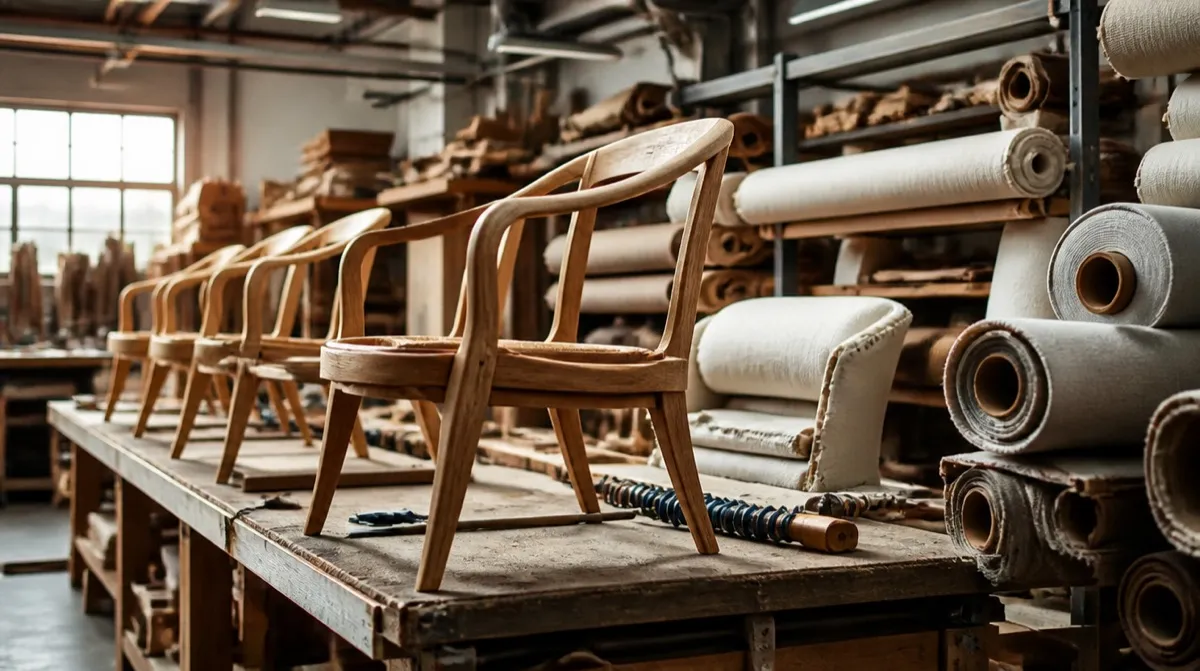
Start researching a large furniture order and you run into a wall of labels. Furniture manufacturers, furniture distributors, wholesale furniture companies, furniture suppliers, wholesale furniture outlets. They get used as if they mean the same thing, and they do not. Each one sits at a different point in the supply chain, and knowing which is which changes how you buy, what you pay, and how long you wait.
This is a buyer's map of how commercial furniture manufacturing works. It covers what a manufacturer actually does, how the tiers between the factory and your loading dock function, the difference between stock and custom production, and how domestic and overseas manufacturing change your lead time and your cost.
Manufacturer, distributor, supplier: who does what
A manufacturer builds the product. That is the factory: the plant that welds the frames, cuts the foam, sews the upholstery, and finishes the casegoods. Some manufacturers specialize narrowly in one category, such as office furniture manufacturers who only build task seating and desking, or educational furniture manufacturers who only build classroom tables and stacking chairs. Others run broad catalogs across hospitality, office, and institutional lines.
A distributor moves product in volume. Furniture distributors buy from manufacturers, hold inventory, and resell to dealers and large accounts. They exist to smooth out supply, so a buyer does not have to wait on a full production run for stocked items.
A supplier is the party you actually buy from. Commercial furniture suppliers and office furniture suppliers sit between the factory and the end buyer. They handle specification, quoting, freight, and the paperwork of a commercial order. A good supplier works across multiple manufacturers, which means they can match a piece to your spec instead of selling you whatever one factory happens to make.
A wholesale furniture outlet or wholesale furniture company usually means a supplier that sells at volume pricing without a traditional retail markup. The word wholesale signals the pricing model, not a separate link in the chain.
The practical takeaway: you rarely buy direct from a factory. Most volume buyers work with a supplier who aggregates manufacturers, and that is by design. It is how you get contract-grade builds without managing a dozen factory relationships yourself.
What makes it commercial-grade in the first place
The reason this chain exists at all is that commercial furniture is a different product than the residential version, built to a higher standard on purpose. A manufacturer building for the contract market engineers durability into every component because the furniture will be used far harder than anything in a home.

Upholstery is the clearest marker. Contract seating is specified to 50,000 or more Wyzenbeek double rubs, the abrasion standard that measures how fabric survives repeated contact. Residential fabric typically rates 10,000 to 15,000. Underneath, commercial foam runs 35 to 40 ILD (indentation load deflection), which holds its shape under constant use instead of flattening within months. Frames, bases, and mechanisms are rated for far more use cycles than their retail equivalents.
In North America, the certification to look for is BIFMA, the Business and Institutional Furniture Manufacturers Association, which sets the commercial testing standards. A BIFMA-certified chair has been independently tested for commercial use. If you want the full breakdown of what the term means, our guide to what contract furniture is covers it in plain English.
Stock production versus custom production
Every manufacturer runs two very different tracks, and knowing which one your order lands on drives your whole timeline.
Stock production means the manufacturer builds to inventory. The piece exists in standard sizes, finishes, and fabrics, and it ships from a warehouse when you order. Stocked items are the fastest way to furnish a space because you are not waiting on a production run.
Custom production means the manufacturer builds to your specification: a particular finish, a graded-in fabric, a nonstandard size, a branded detail. Custom work gives you exactly what you drew, and it costs more and takes longer because it enters the factory queue as a new run.
The number that matters here is lead time. Custom finishes and casework typically carry a 10 to 14 week lead time, while stocked items ship fast. On any project with a fixed opening date, sort your selections into stocked and custom early, use stock where it fits, and reserve the custom lead time for the pieces that truly need it. Our commercial furniture lead times guide walks through how to build a schedule backward from your move-in date.
Domestic versus overseas manufacturing
Where a piece is built shapes both its price and its timeline, and there is no single right answer.

Overseas manufacturing, mostly across Asia, tends to carry a lower unit cost, which is why so much of the volume market runs through it. The trade-off is the ocean freight window and less flexibility once a container is in transit. Overseas production rewards planning ahead and ordering in full quantities.
Domestic manufacturing tends to carry a higher unit cost and a shorter, more controllable lead time, with easier custom runs and reorders. For projects that need speed, tight finish matching across phases, or small custom quantities, domestic can be worth the premium.
Most large orders end up as a mix. A supplier who works across both can put stocked overseas product where cost matters and domestic product where speed or custom flexibility matters. That blend is one of the main reasons volume buyers use a supplier rather than sourcing factory-direct.
Comparing the tiers at a glance
| Tier | What they do | You buy from them when | | --- | --- | --- | | Manufacturer | Builds the product in a factory | You need a large single-SKU custom run and can manage the factory relationship | | Distributor | Holds inventory, resells in volume | Rarely direct; they supply dealers and suppliers | | Supplier | Specs, quotes, freights the order across many manufacturers | Almost always, for a full commercial project | | Wholesale outlet | A supplier selling at volume pricing | You want contract-grade builds without retail markup |
How to buy through the chain
The most reliable path for a volume order is to work with one supplier who can pull from multiple manufacturers, match builds to your spec, and consolidate the order into a single freight and a single point of contact. That is faster than juggling factories and cleaner than buying piecemeal from retail.
A few practices make the process go smoothly. Request physical samples before you commit, because finish and fabric color on a screen is not reliable. Ask which items are stocked and which are custom, so you know your real timeline. Confirm volume price breaks, which typically step down at 50, 100, 250, and 500 or more units, so you can decide whether ordering the full quantity at once beats phasing. And budget freight and installation from the start, because they typically add roughly 14 to 26 percent over the furniture cost.
To model the delivered cost of a full order before you commit, run the numbers through our furniture cost calculator, and when you are ready to price real quantities against real manufacturers, request a quote. You can also browse contract-grade builds directly in the seating and table categories to see the range these specs describe.