"Contract grade" gets used loosely enough in furniture marketing that buyers sometimes assume it's a vague quality claim rather than an actual standard. It isn't. Contract grade refers to a specific set of construction, testing, and durability expectations that furniture has to meet to be sold into commercial and hospitality environments, and there are real numbers behind it, not just a sturdier-sounding label on the same product.
The BIFMA framework
BIFMA, the Business and Institutional Furniture Manufacturers Association, publishes the testing standards that the commercial furniture industry uses to evaluate durability. These standards cover things like how many cycles a chair joint can withstand under repeated load, how much weight a frame holds before failure, and how stable a piece stays under off-center loading, someone sitting on the edge of a seat, leaning back at an angle, or putting weight on an armrest.
A piece that's tested and rated to these standards has been through cycle testing that simulates years of daily commercial use in a lab setting before it ever ships. A piece that isn't tested to these standards may hold up fine in a living room and still fail within months in a restaurant or lobby, because the load patterns and frequency of use are entirely different environments.
Fabric ratings and double rubs
Fabric durability in the commercial furniture world is measured in double rubs, a standardized abrasion test (Wyzenbeek is the common method) that simulates the wear a fabric takes from repeated sitting, sliding, and cleaning cycles. A higher double-rub number means the fabric holds up to more use before it shows wear.

Residential fabric commonly falls well below what's considered commercial-grade. Commercial upholstery for general use typically starts around 15,000 double rubs, and heavy-traffic environments (restaurants, lobbies, waiting areas) call for fabric rated 30,000 double rubs or higher, with some heavy-use programs specifying 50,000 or more. When comparing two fabrics that look and feel similar, the double-rub rating is the number that actually tells you which one survives daily commercial traffic. Use the fabric durability checker to compare options against your expected traffic level before finalizing a spec.
Flame standards
Commercial furniture destined for hospitality and public spaces generally has to meet flame resistance standards that go beyond typical residential requirements, since these are spaces with higher occupancy and different code requirements than a private home. The specific standard that applies depends on jurisdiction and building type, so check local code and your project's fire marshal requirements directly rather than assuming a generic standard applies everywhere. What's consistent across markets is that commercial furniture manufacturers build and test to meet these requirements as standard practice, while residential product generally is not built or tested against them at all.
Frame construction standards
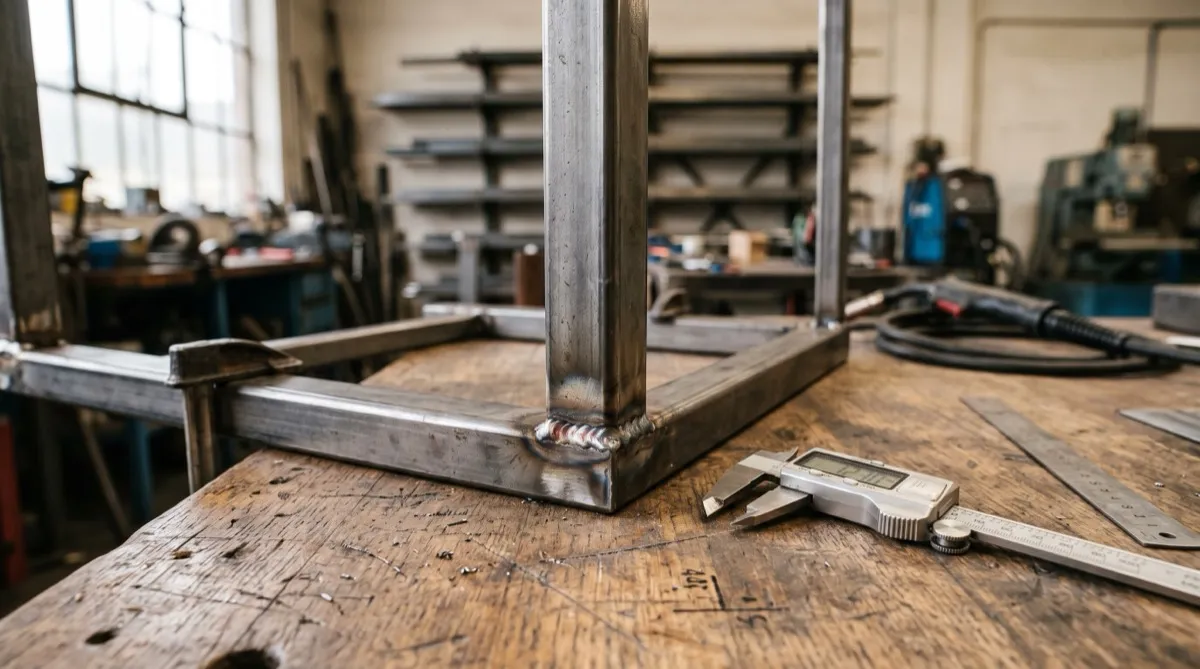
Contract grade frame construction centers on welded joints rather than mechanical fasteners like screws, cam-locks, or adhesive. A welded joint distributes stress across the connection point and holds up to repeated flexing and load over years. A screwed or glued joint loosens under the same repeated stress, which is why furniture that looks structurally similar in a photo can have wildly different service lives once it's in daily commercial use.

Frame gauge, the thickness of the steel or aluminum tubing used, is the other half of the equation. Heavier gauge tubing resists bending and fatigue under repeated load better than lighter gauge tubing, even when the joint construction is identical. Ask for the actual gauge specification when comparing two frames that look similar, since visual similarity tells you nothing about wall thickness.
Warranty language as a signal
Warranty terms are one of the most reliable, and most overlooked, signals of whether a piece is actually built to contract standard. A manufacturer confident in frame and fabric durability typically backs a commercial piece with a multi-year warranty that explicitly covers commercial use. A manufacturer that only offers a short warranty, or one that excludes commercial use in the fine print, is telling you something about how the product was actually engineered, regardless of what the listing calls it.
Read warranty language closely before ordering in volume. "Commercial use" language in a warranty is a strong positive signal. A warranty that's silent on use case, or that specifically limits coverage to residential settings, is a red flag on a piece being marketed as contract grade.
Why this matters for your spec
Buyers who understand what contract grade certifies can ask suppliers pointed, specific questions instead of relying on marketing language: what's the frame gauge and joint construction, what's the fabric's double-rub rating, what flame standard does the piece meet, and does the warranty explicitly cover commercial use. A supplier that answers all four clearly is quoting real contract grade product. A supplier that can't is likely quoting something dressed up to look like it.
Our contract furniture buyers guide walks through how these standards apply across categories, from dining chairs to lounge seating to case goods, if you're building a spec that needs to hold up across an entire property.
Getting a spec that meets standard
If you're specifying furniture for a hospitality, restaurant, or institutional project and want confirmation that frame, fabric, and flame ratings actually meet contract grade for your use case, request a quote with your project type and we'll spec the details in writing rather than leaving it to a catalog description.