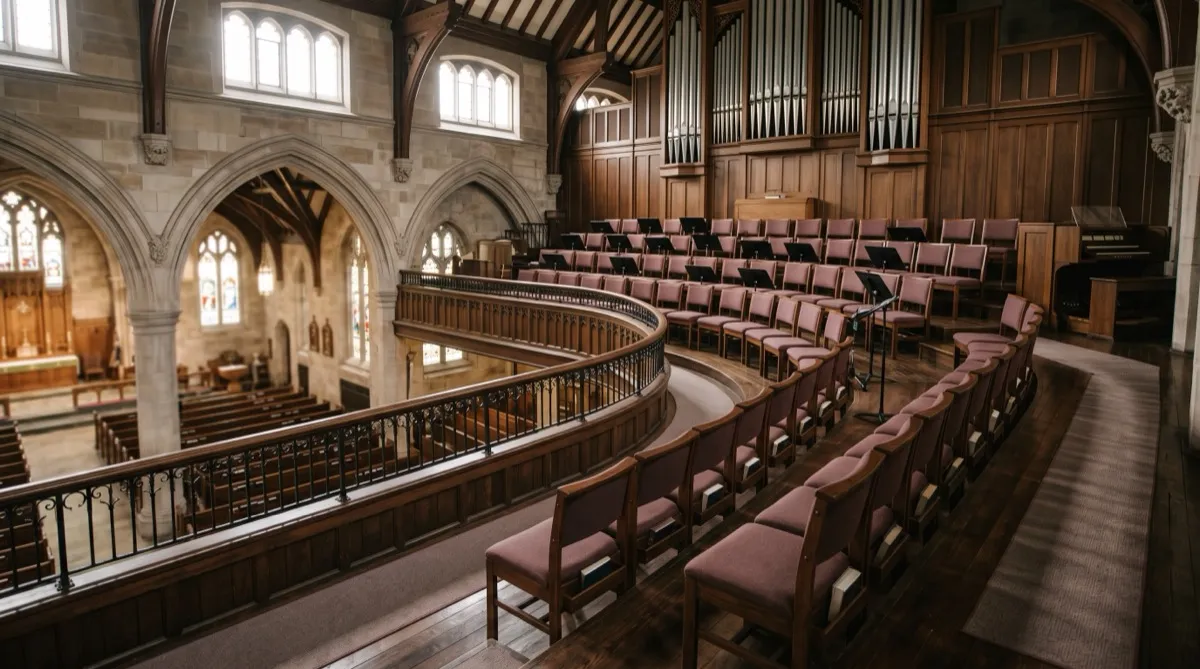
Make choir seating a separate brief with the music director: seated rehearsal, standing transitions, music access, riser positions and storage. Compare the proposed chair and riser assembly in those tasks rather than assuming worship seating is unsuitable or a choir label establishes singing performance.
Why choir chairs are a different category
Have the music director define the seated rehearsal and performance tasks, including standing transitions and access to music. Compare candidate chairs with singers of different sizes in a supervised trial. A firm, higher, or shallower seat is not automatically better for singing, and this guide does not establish a ribcage, breathing, or sound outcome from chair dimensions.
Record usable seat depth, cushion firmness, seat angle, back shape, and foot support separately. Ask participants and the music director to assess the proposed chair during the intended activity; a seat pan or lumbar profile alone does not establish neutral pelvic position or unrestricted breathing for every singer.
Compact footprints for risers
Choir risers are tight real estate. Rows are close together, and the chair footprint has to fit the riser depth without crowding the row behind it. A chair with a wide swing radius or deep legs eats into that spacing fast, and a loft or platform choir room usually cannot afford to lose the inches.
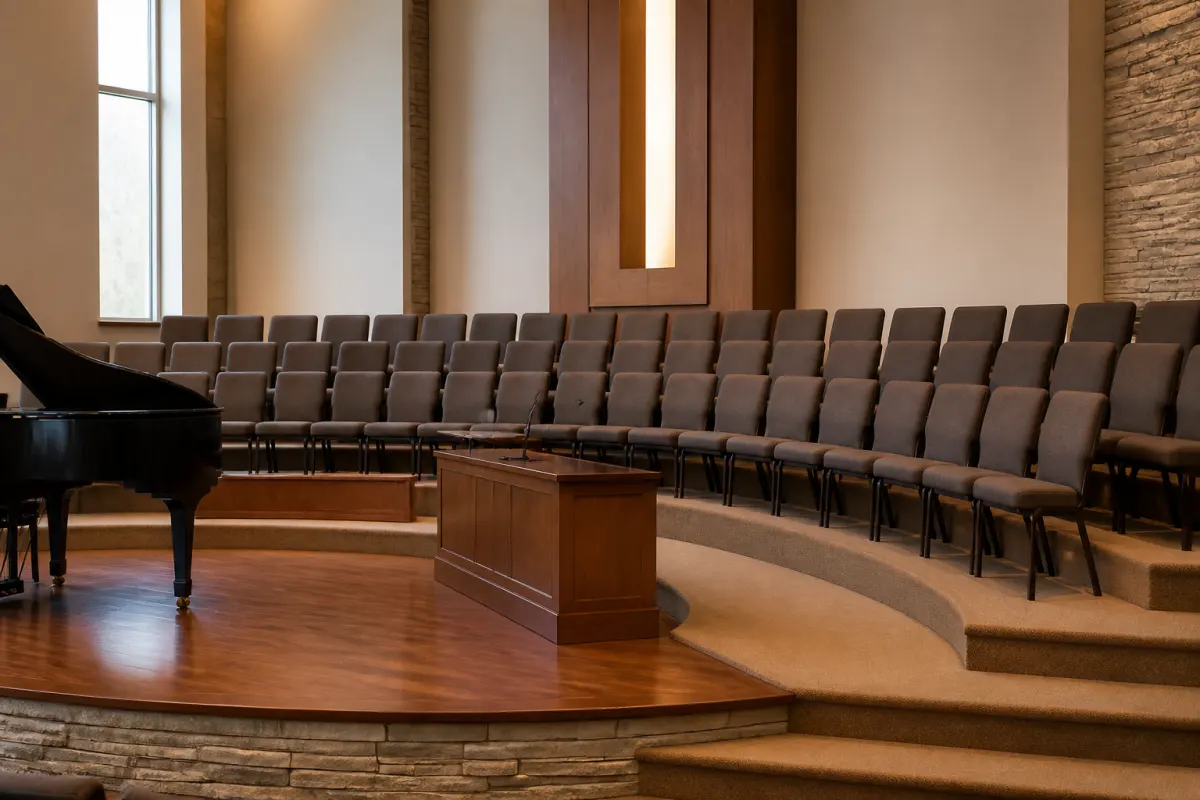
If stacking is needed, compare the actual chair footprint on the riser with its documented stack and compatible cart. A stacking frame is not necessarily narrower than another style, and ganging does not guarantee that chairs cannot shift. Obtain the riser provider's approval of the chair positions and any permitted connections.
Fabric and finish for a choir loft
Inspect the proposed cover, seams, and frame finish with the robes or clothing used by the choir. Ask for approved cleaning and textile test documents, and check snag points on a sample; a mid-weight or commercial label does not establish suitability.
Color choice in a choir loft often gets overlooked until the space is under stage lighting. A fabric that reads fine under house lights can look flat or shiny under spotlights. If the choir loft is lit for services or recorded, ask for fabric samples under similar lighting before finalizing an order.
Coordinating with risers
Coordinate the chair and riser drawings, whether purchased together or separately. Record tread depth and height, chair feet, occupied positions, guardrail locations and the riser provider's permitted arrangement. A half inch difference can be an illustrative fit comparison, but it does not predict a singer's foot position or prove safety; obtain the actual assembly review before ordering.
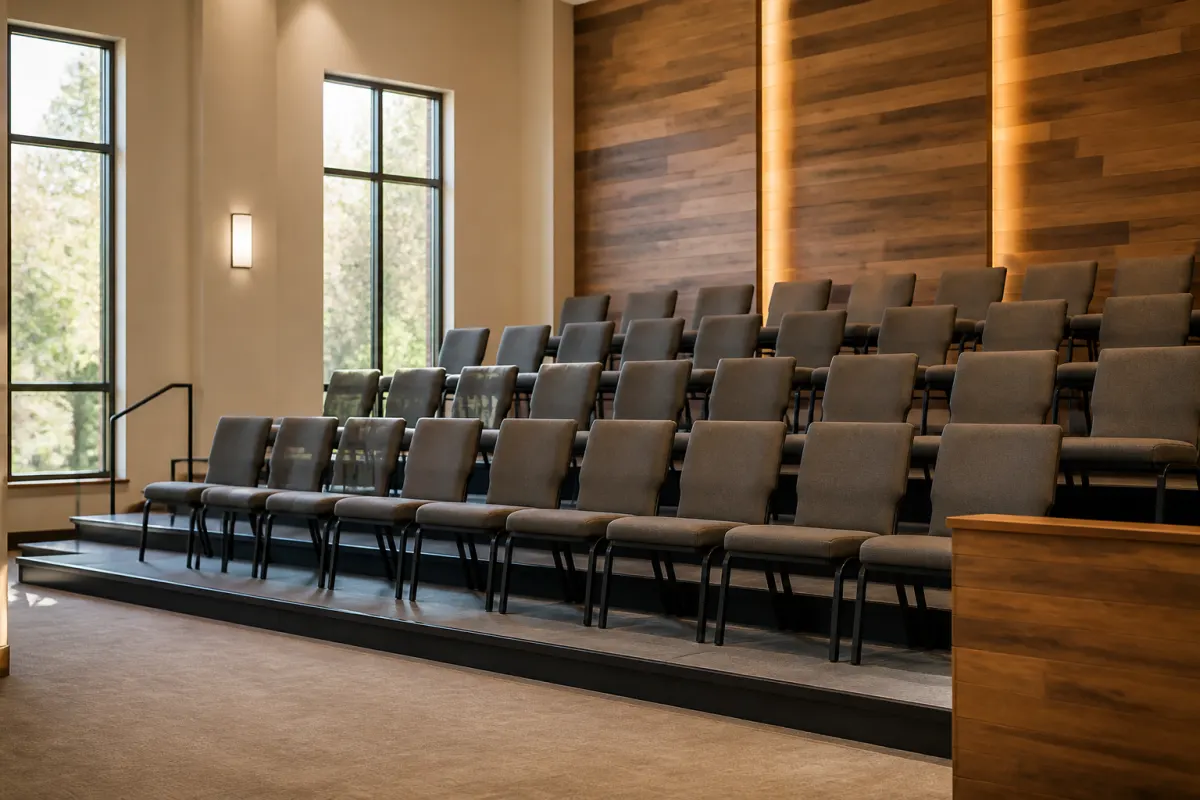
If replacing chairs and risers together, assign one coordinator to reconcile approved drawings, chair count, spacing and riser requirements. Purchase sequence alone does not establish a mismatch or correct occupied fit.
Storage and quick changeover
If the choir loft changes use, test the selected chair and rated cart along the actual route to storage. Measure the complete reset time, including connections, loading, door turns, and safe parking; a rolling cart does not guarantee a changeover in minutes.
Music stands, folders, and hymnals also need a home. Some choir chair frames accept a book rack or music holder attachment on the back, which keeps materials organized without a separate piece of furniture cluttering a tight loft. If the loft space is small, this kind of built-in storage is worth prioritizing over a chair that looks slightly nicer but adds nothing functional.
Ordering for growth
Choirs change size season to season and year to year. Order a small reserve beyond current headcount, stored flat or stacked nearby, so a growing choir or a guest ensemble does not mean scrambling for mismatched chairs from another room. This is inexpensive insurance against a visibly patchworked loft during a high-attendance service like a holiday concert.
Browse the banquet chair category for furniture concepts to discuss. A category label does not establish that a chair was designed for singers or approved for a particular riser; obtain the chair and riser documents and test the proposed seating arrangement with the music director.
For a choir loft or sanctuary inquiry, request a quote with the riser drawing, chair count, music-stand needs, and budget dates. Ask any responding supplier for exact chair dimensions and handling instructions, and have the riser provider confirm the proposed arrangement and load before approving it.